He was only lagging pipes. That is how it gets described, forty years later, in a consulting room in Cork or Drogheda or Tralee, usually by a wife or a daughter, usually after the breathlessness has already been put down to age, or weight, or the forty cigarettes a day he gave up in 1991. He was a plumber, or a fitter, or a carpenter, or he spent two summers as a young fella stripping out a boiler house because the money was good. Nobody wore a mask. Nobody was told to. And then nothing happened for four decades.
Asbestos is the rare occupational exposure that does its worst work after retirement. Ireland banned it, cleaned up its building sites, rewrote its regulations as recently as last December, and in doing so created a new national register of asbestos-related disease. What it has not done is update the list of diseases it will actually compensate. Irish safety law now names seven illnesses that asbestos can cause. Irish social welfare law recognises two of them.
TL;DR
- Asbestos diseases take 15 to 60 years to appear, which puts the Irish exposure of the 1960s to the 1990s squarely in people’s seventies and eighties now.
- The National Cancer Registry recorded an average of 51 new mesothelioma cases and 45 mesothelioma deaths a year in Ireland for 2021 to 2023, four out of five of them in men.
- Roughly two thirds of a man’s lifetime mesothelioma risk in Ireland arrives after his 75th birthday, on the Registry’s own figures.
- New regulations in force since 21 December 2025 oblige every doctor in Ireland to report a diagnosed asbestos-related occupational disease to the Health and Safety Authority, and list seven such diseases.
- Only two of those seven, asbestosis and diffuse mesothelioma, are prescribed diseases for Disablement Benefit. Asbestos-related lung cancer and non-malignant pleural disease are not.
- Disablement Benefit is payable alongside the State Pension and is disregarded for the Fuel Allowance means test, but nobody will raise it for you.
- The live exposure risk today is renovation. Any Irish building put up or refurbished before 2004 may contain asbestos, and Ireland has supported more than 244,000 home energy upgrades since 2019.
The arithmetic of a forty-year delay
The Health and Safety Authority is blunt about the timeline. Asbestos-related diseases, it says, “will not occur immediately and can take from 15 to 60 years to develop”. Sixty years is a working lifetime and then some. A 24-year-old apprentice on a Dublin site in 1972 is 78 now.
That delay shows up with unusual clarity in the Irish cancer figures. In its annual statistical report covering 1994 to 2023, the National Cancer Registry puts mesothelioma (the cancer of the lining of the lung, heart or abdomen that is caused by asbestos and almost nothing else) at a three-year annual average of 51 new cases for 2021 to 2023: 41 in men and 10 in women. Deaths over the same period averaged 45 a year, 35 of them men. Those two numbers sitting almost on top of each other tell you most of what you need to know about the prognosis.
The more revealing pair of numbers is further along the same row. The Registry estimates an Irish man’s risk of developing mesothelioma before his 75th birthday at about 1 in 1,641, and his lifetime risk at about 1 in 511. Put those together and the lifetime figure is more than three times the by-75 figure, which means roughly 69 per cent of a man’s mesothelioma risk in this country falls after he turns 75. That arithmetic is ours, not the Registry’s, but it follows directly from its published table. For women the equivalent share is about a third.
This is not a disease of working life. It is a disease that waits until the work has been forgotten, the employer has been wound up, the P45s have been thrown out and the man himself has stopped thinking of himself as a tradesman at all.
Who was exposed, in Ireland, in practice
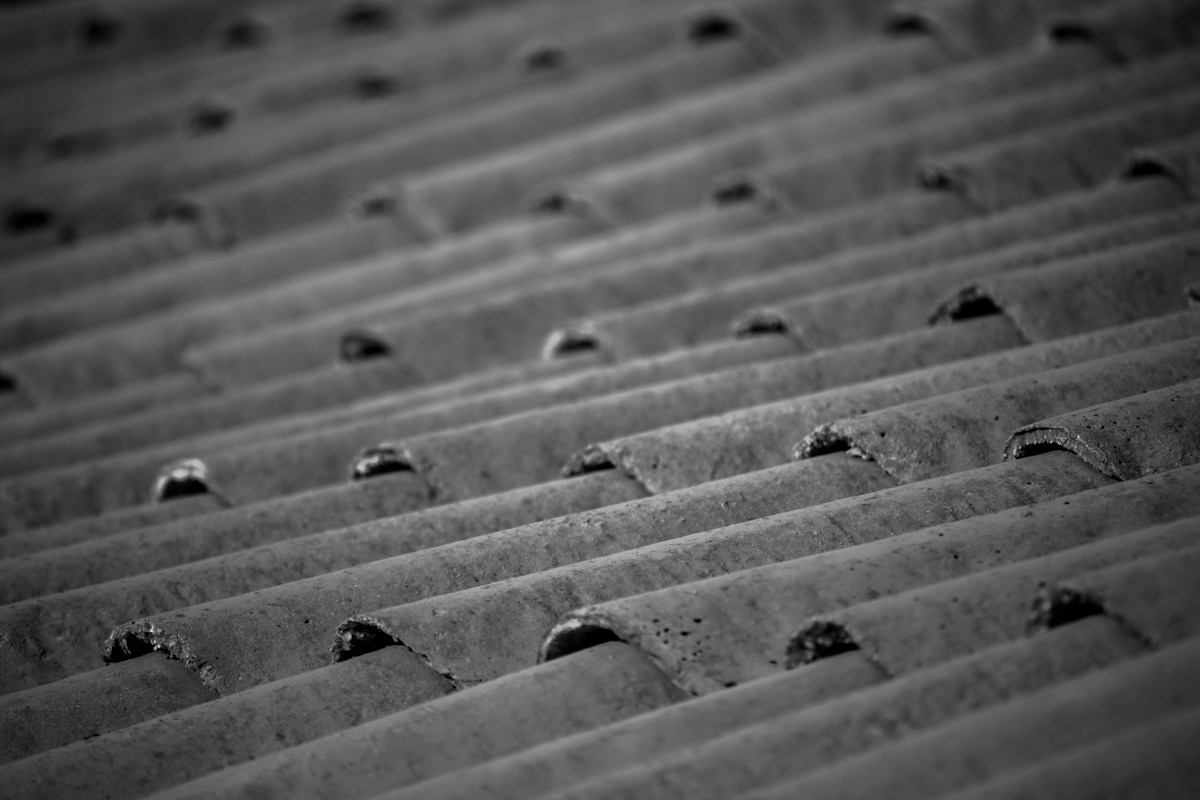
Asbestos was not exotic. It was lagging on pipes and boilers, insulating board in ceilings and around fireplaces, corrugated cement sheeting on garage and shed roofs, cement gutters and downpipes, textured coatings on walls, floor tiles, fire doors, airing cupboards, fuse boards and the backs of old storage heaters. It was in schools, hospitals, local authority housing, creameries, ESB stations, ships and the fit-out of nearly every commercial building of the period.
So the exposed group is wider than the people who worked with asbestos deliberately. It includes plumbers, electricians and carpenters who drilled through it without knowing, labourers who swept up after someone else, and dockers and shipyard workers. It also includes people who were never on a payroll at that site at all: the wives and mothers who shook out and washed overalls that came home grey with dust. Ovarian cancer appears on the list of asbestos diseases for a reason, and that reason is not occupational in the ordinary sense.
Críonna Health has written before about lung fibrosis after 50 and about lung cancer and the risk that does not reset after quitting. Asbestos sits underneath both, and it is the thing least likely to be asked about in either consultation.
What changed on 21 December 2025
Ireland’s asbestos rules were rewritten last winter. The Safety, Health and Welfare at Work (Exposure to Asbestos) (Amendment) Regulations 2025 (S.I. No. 632 of 2025) were signed by Alan Dillon, Minister of State at the Department of Enterprise, Tourism and Employment, notified in Iris Oifigiúil on 30 December 2025, and came into operation on 21 December 2025, giving effect to Directive (EU) 2023/2668.
Most of the coverage, such as it was, focused on the workplace limit. The exposure limit value is now 0.01 fibres per cubic centimetre, and nearly all asbestos work is notifiable to the Authority at least ten days in advance, with a permit number issued before work can start.
Two quieter changes matter far more to anyone reading this at 70.
The first is a new Regulation 24, which establishes a Register of Asbestos-Related Occupational Diseases maintained by the Health and Safety Authority. Where a registered medical practitioner becomes aware of a case of an asbestos-related occupational disease, the regulation requires them to report it to the Authority in writing. Until last December, Ireland had no national count of these diagnoses at all. From now on it will have one, which means the scale of the problem becomes visible for the first time at precisely the moment the exposed cohort reaches its eighties.
The second is the replacement of Schedule 5, Part B, which sets out, in the State’s own words, the diseases that “exposure to free asbestos fibres can give rise to”:
- asbestosis
- mesothelioma
- lung carcinoma
- gastro-intestinal carcinoma
- carcinoma of the larynx
- carcinoma of the ovary
- non-malignant pleural diseases
That is Ireland, in a statutory instrument made in December 2025, naming seven diseases.
The list that pays out names two
Compensation for occupational disease in Ireland runs through the Occupational Injuries Scheme, and the diseases it covers are set out in Schedule 4 of the Social Welfare (Consolidated Occupational Injuries) Regulations 2007 (S.I. No. 102 of 2007). Read it against the list above and the gap is immediate.
Two of the seven are there. Diffuse mesothelioma is listed at A.10, prescribed against the working or handling of asbestos, the manufacture or repair of asbestos articles, the cleaning of plant used in those operations, or “substantial exposure to the dust arising from any of the foregoing operations”. Pneumoconiosis is listed at A.7, and the Regulations define pneumoconiosis as fibrosis of the lungs due to mineral dust “including silica dust, asbestos dust and coal dust”, which is how asbestosis gets in.
The other five are not. There is no entry for asbestos-related lung cancer. The only primary lung carcinoma in the whole Schedule is prescribed against nickel refining. There is no entry for laryngeal cancer, none for ovarian cancer, none for gastro-intestinal cancer attributable to asbestos, and, strikingly, none for non-malignant pleural disease, which is the diffuse pleural thickening that leaves people genuinely short of breath and is a recognised prescribed disease across the water in the United Kingdom.
That is not an argument that nobody can ever be compensated. Article 22 of the same Regulations lets the Minister accept, on evidence including medical reports, that a disease was due to the nature of a person’s insurable employment even where the occupation is not the prescribed one. But it is a route that has to be fought for, by someone who is usually ill, usually in their seventies or eighties, and who has no idea the route exists.
The one-month rule written for a forty-year disease
There is a second structural problem, and it is sharper.
Article 24(1) of the 2007 Regulations provides the presumption that makes these claims workable: where a person develops a prescribed disease, it is presumed, unless the contrary is proved, to be due to their insurable employment, if they were employed in the relevant occupation on, or at any time within one month immediately preceding, the date on which they are treated as having developed the disease. And for a disablement benefit claim, Article 26(2)(b) fixes that date of development as the day the person first suffered the relevant loss of faculty. In other words: now.
One month. For a disease whose defining characteristic is that it arrives decades after the last day on the tools.
The drafters clearly understood the problem, because Article 24(2) gives bespoke presumption rules to the other long-latency entries. Occupational deafness and byssinosis get an unconditional presumption. Tuberculosis gets a window of up to two years after the relevant employment ends. Pneumoconiosis, and therefore asbestosis, gets a rule based on an aggregate of at least two years in a listed occupation, with no requirement that the work be recent.
Diffuse mesothelioma is not in that list. The disease with the longest latency on the entire Schedule is the one left relying on a rule that assumes you were still at the job last month. Nothing prevents a claim: the presumption is a shortcut, not a gate, and its absence means the claimant must prove the link themselves rather than having it assumed. But the practical effect is that the heaviest evidential burden in the scheme falls on the people least able to carry it.
What to actually do
Tell your GP your work history, by name and by decade. “I was a fitter in a Cork dockyard from 1968” is clinical information. It changes what a chest X-ray gets looked at for, and since last December it also triggers a reporting duty if a diagnosis follows. Bring jobs you left fifty years ago, summer work, and work you did for cash.
If a diagnosis is made, ask about Disablement Benefit explicitly. It is payable where the loss of faculty is assessed at 15 per cent or more: a weekly pension at 20 per cent and above, a lump sum (Disablement Gratuity, which is not taxable) below that. You must have been in insurable employment at PRSI Class A, B, D, J or M on or after 1 May 1967. Crucially, it is a compensation payment, not a means-tested one: it is paid alongside the State Pension, and it is disregarded for the Fuel Allowance means test. At 50 per cent or more, Constant Attendance Allowance may be added where someone needs daily help at home.
Mind the clock. The claim form is the OB21 and the Department asks for it within three months of the onset of the disease, or of becoming aware of the disablement. If you are not yet disabled but know you were exposed, you can apply separately for a declaration that your disease or accident was occupational, which safeguards a future right to benefit. Very few people know this exists.
Get help with the paperwork. Citizens Information can walk through the forms, and advocacy support is worth asking for where someone is unwell. If a claim is refused, there is a formal social welfare appeal.
The exposure that is happening now
None of this is only historical. Asbestos was restricted in the European Union from 1999 and is now prohibited under the REACH Regulation, but material already installed or in service before 1 January 2005 is allowed to stay where it is until it is disposed of or reaches the end of its service life. The Health and Safety Authority’s position is that asbestos may be present in any industrial, commercial, public or residential building built or refurbished before 2004, and the 2025 Regulations require a survey before demolition, maintenance or renovation work on premises built before 31 December 2004.
Which brings us to the retrofit. Under the National Residential Retrofit Plan, published in January 2026, Ireland has supported more than 244,000 home energy upgrades since 2019, with grant schemes expanding and a reformed Warmer Homes Scheme aimed at households at risk of energy poverty. Those households skew older and their houses skew older still. Pumping cavity walls, lifting attic floors, ripping out a back boiler, replacing a garage roof or taking down an old ceiling in a 1974 semi are all plausible ways to disturb asbestos that had been sitting there harmlessly for fifty years.
Here is the uncomfortable part. The Asbestos Regulations protect employees. A 72-year-old homeowner in a dust mask from the hardware shop, clearing out their own shed on a Saturday, is outside that regime entirely. The law that would have stopped a contractor doing exactly the same thing does not reach them.
So, practically: assume anything in a pre-2004 building may contain asbestos until a competent person says otherwise. Undamaged material left alone is not releasing fibres and is generally safer in place than badly removed. Do not drill, sand, cut, break or power-wash suspect material, and never use an ordinary vacuum on the debris. If work is planned, ask for a refurbishment and demolition asbestos survey before it starts, not after. And note that under the Construction Regulations 2013, asbestos counts as a “particular risk”, which obliges a homeowner to appoint project supervisors for the job even on a small domestic project. The Authority publishes a short guide for homeowners and can be reached on 0818 289 389.
The quiet part
Ireland spent 2025 building the machinery to count this. The register is real, the duty on doctors is real, and the list of seven diseases in Schedule 5 is the State saying plainly what asbestos does. The machinery to compensate it was last meaningfully set out in 2007, recognises two of those seven, and hands the longest-latency disease of them all a presumption rule with a one-month window.
That gap will not close because people in their seventies notice it. But a man who tells his GP he lagged pipes in 1974, and a family who ask about Disablement Benefit on the day of the diagnosis rather than six months after the funeral, are doing the only two things that reliably change the outcome for an individual. It costs nothing to say the word asbestos out loud in a consulting room. It has, for a lot of Irish families, cost a great deal not to.
Críonna Health publishes evidence-informed guidance on ageing well in Ireland, including the entitlements that go unclaimed because nobody mentions them. This article is general information and not a substitute for medical or legal advice; for a decision on your own entitlements, contact the Department of Social Protection or Citizens Information.
📷 Photo by Saifee Art on Unsplash