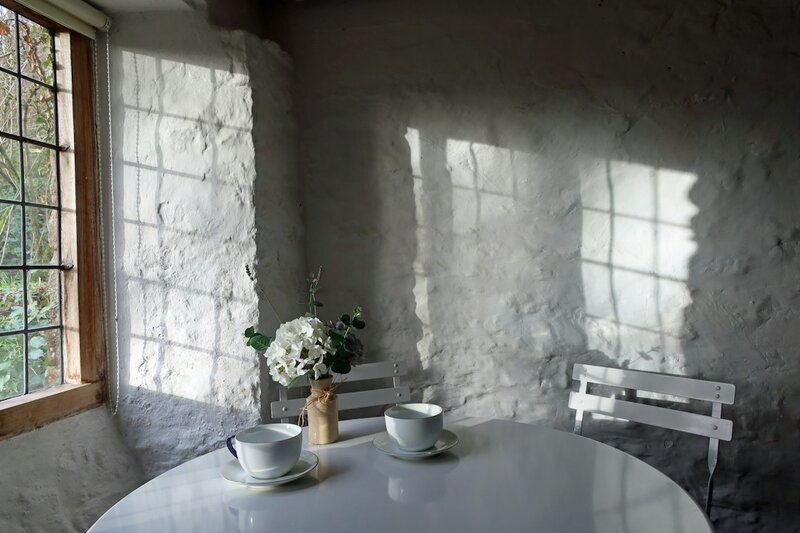
It is rarely the hearing that gets mentioned first, and almost never the sight. What gets mentioned is the withdrawal. She used to be the one holding the table together at a family lunch, and now she sits at the end of it, pleasant and absent. She has stopped ringing people. She says the television is no good any more. At Mass she nods at the right moments but does not join in. Somebody in the family says the sentence out loud for the first time in the car on the way home: she has gone very quiet lately, do you think there is something going on?
Her hearing has slipped. Not dramatically, and not enough for anyone to make an appointment about it. Her sight has slipped too, a bit of cataract, a bit of macular change, nothing that stopped her reading the paper last year. Taken one at a time, neither loss is bad enough to trigger anything at all in the Irish health system. Taken together, they have quietly removed her from the room.
This is combined vision and hearing loss, usually called dual sensory loss or deafblindness, and it is one of the most consequential things that happens to people in their eighties that almost nobody is looking for.
TL;DR
- Census 2022 counted 70,443 people in Ireland who reported both a vision impairment and a hearing impairment. Of those, 47,847 were aged 65 or over and 15,234 were aged 85 or over, which is roughly one in five of everyone in the country at that age.
- Combined loss is not the sum of two losses. Each sense normally covers for the other. When both go, the usual coping strategies cancel out, which is why withdrawal can be dramatic while each individual test result still looks unremarkable.
- It is routinely mistaken for cognitive decline. Standard memory tests depend on hearing the instructions and seeing the pictures. The 2024 Lancet Commission also lists hearing loss as the single largest modifiable dementia risk factor and added untreated vision loss as a new one.
- Ireland agreed to recognise deafblindness as a distinct disability in 2015 and never did. The Oireachtas Joint Committee on Health and Children heard the case on 28 May 2015. England has required a specialist deafblind assessment since 2001.
- There is money on the table that most people never claim. PRSI Treatment Benefit pays up to €500 per hearing aid, €1,000 for a pair, every four years, plus a free eye test every two years.
One plus one equals three
The widely used European definition is deliberately functional rather than clinical: a person is regarded as deafblind if their combination of vision and hearing loss causes difficulty with access to information, communication and mobility. There is no decibel threshold and no visual acuity cut-off in that sentence. It is about what the combination does to a life.
The reason it matters is that the two senses normally rescue each other, constantly and invisibly. Someone with reduced hearing lipreads without ever calling it lipreading. They read the room, watch faces, track who is about to speak. Someone with reduced sight navigates by sound: the echo of a hallway, the kettle, a voice telling them where the step is. Each strategy is borrowed from the other sense. Lose a little of both and you do not lose two things, you lose the borrowing.
Laura English of the Anne Sullivan Centre put this to the Oireachtas committee in the plainest terms available. “Deafblindness is not, therefore, deafness plus blindness,” she told members, “rather, it is a separate and unique disability that affects overall development, socialisation and communication. One plus one equals three.”
That arithmetic explains the thing families find hardest to square. The audiogram comes back as mild to moderate age-related loss. The eye clinic says the cataract is not ready yet. Both clinicians are correct, and the person is still unable to follow a conversation in a kitchen with a radio on, still unwilling to cross a car park, still disappearing.
The Irish number nobody publishes
Ireland does not keep a register of people with combined sensory loss, so there is no official figure to quote. There is, however, a way to get one out of the census.
Census 2022 asked separately about blindness or a vision impairment and about deafness or a hearing impairment, and the CSO publishes the cross-tabulation as dataset F4060. Run the two against each other and the answer is 70,443 people in Ireland who reported both. That is not a rounding error on the headline figures of 297,000 with a vision impairment and 233,000 with a hearing impairment. It is nearly a quarter of the first group.
The age gradient is the part worth sitting with. Of those 70,443, some 47,847 were aged 65 or over. The count rises through every band and then jumps: 9,188 people in their late seventies, 9,035 in their early eighties, and 15,234 aged 85 and over. Set that last figure against the 84,358 people the CSO counted at 85 and over in April 2022 and you get roughly one in five. Narrow it to those reporting both impairments to a great extent and you still have 6,451 people nationally, 2,001 of them aged 85 or over.
For comparison, when the Anne Sullivan Centre commissioned a cross-tabulation of the 2011 census it found 1,749 people reporting both severe vision and severe hearing impairment, and 10,365 once those with additional disabilities were included. Those are the numbers still quoted in most Irish discussion of deafblindness. The 2022 cross-tab says the population living with the functional problem is several times larger than the one the services were ever designed around, and that it is overwhelmingly a population of people in their late seventies and eighties who have never once been described, to themselves or anyone else, as deafblind.
Why it gets written down as confusion
Put yourself in the chair. Someone is talking to you, slightly too quickly, in a room with a bit of background noise, and you can neither hear the consonants nor see the face clearly enough to fill them in. You will mishear. You will answer the question you thought was asked. You will say “I’m grand, yes” to things you did not catch, because asking a third time is exhausting and mildly humiliating. From the other side of the table, that looks exactly like early dementia.
It is worse in the one setting where it does most damage. Standard cognitive screening tools are built almost entirely out of hearing and vision. You are asked to repeat spoken words, to copy a drawing, to name pictured animals, to read an instruction off a page, to draw a clock face. Administered to someone with untreated combined loss, these tests measure sensory access at least as much as cognition, and the research literature on cognitive assessment in dual sensory impairment is blunt that results can be rendered unreliable or invalid.
The error runs in both directions, which is why it deserves naming rather than reassurance. Some people are labelled cognitively impaired when the honest finding is that they could not hear the test. Others have a genuine, treatable dementia missed because everyone decides it is only the ears. And the relationship is real, not merely an artefact: the 2024 Lancet Commission on dementia prevention identified fourteen modifiable risk factors accounting for up to 45% of cases worldwide, kept hearing loss as the largest single one, and added untreated vision loss as a new entry. Correcting what can be corrected is not cosmetic.
Ireland agreed to fix this in 2015
On 28 May 2015 the Oireachtas Joint Committee on Health and Children held a session recorded in the official report under the heading “Recognition of Deafblindness as Distinct Disability: Discussion”. It was, as the acting chair noted at the time, the first Oireachtas broadcast made accessible to the deafblind community, a detail that tells its own story.
The committee heard that in 2001 the United Kingdom had issued policy guidance requiring every local authority to identify deafblind people in its area and to appoint a senior staff member responsible for ensuring they were assessed and served. England has since gone further: under statutory guidance accompanying the Care Act 2014, an assessment of someone who is deafblind must involve an assessor with specific training and expertise in deafblindness. The committee also heard that Irish MEPs had signed European Written Declaration 2004/1 on 1 April 2004, urging member states to recognise deafblindness as a distinct disability requiring specialist support. Eight member states adopted it. Ireland has not.
The committee agreed. Members said so on the record and undertook to bring it to the Minister. Ireland went on to ratify the UN Convention on the Rights of Persons with Disabilities in March 2018, a convention that distinguishes explicitly between people who are deaf, people who are blind and people who are deafblind. In May 2025 the Anne Sullivan Centre marked the tenth anniversary of that committee session by noting that the recognition still had not happened. It has not happened in 2026 either.
The practical consequence is the one Laura English described to the committee: people who are deafblind are “divided into parts for support and assistance, without a dedicated professional to co-ordinate the diverse range of services currently available”. You are referred to audiology for your ears and to an eye service for your eyes. Each service does competent work on its own organ, and each quietly assumes the other sense is doing the compensating. Nobody is funded to look at the combination, because in Irish health policy the combination does not formally exist.
What you can actually get right now
None of that is a reason to wait. The supports that exist are worth using, and a great many people over 70 are entitled to things they have never claimed.
PRSI Treatment Benefit is the big one, and it does not stop at retirement. The Department of Social Protection pays the full cost of a hearing aid up to €500, or €1,000 for a pair, once every four years, plus up to €100 towards repairs. It also covers a free eyesight test every two years and a set payment towards glasses, with basic frames free. People aged 66 and over qualify on 260 PRSI contributions paid at any time plus a contribution condition in the relevant tax year, and many qualify as a dependent spouse on their partner’s record without realising it. Ask the provider to check your eligibility before you commit to anything.
If you hold a medical card, HSE community audiology is free, including hearing aids, on GP referral. Be realistic about timelines: waiting lists in many areas run to a year or more, so put the referral in now rather than when it becomes urgent, and use Treatment Benefit in the meantime if you qualify for both.
Vision Ireland, the national sight loss agency formerly known as the NCBI, provides free vision rehabilitation that has nothing to do with eye medicine: lighting and contrast assessments at home, mobility training, magnification, and technology support. Its InfoLine is 1800 911 250, Monday to Friday, 9am to 5pm. We have written separately about what vision rehabilitation actually involves.
Chime, the national charity for deafness and hearing loss, runs resource centres around the country and an information line on 1800 256 257, and can advise on assistive equipment such as amplified phones, loop systems and visual alerting devices.
The Anne Sullivan Centre in Dublin is the only Irish organisation specialising specifically in deafblindness, and its outreach service will talk to families who are not and never will be residential clients. Contact is through annesullivan.ie or info@annesullivancentre.ie.
Finally, the Housing Adaptation Grant for People with a Disability, administered by local authorities, can fund lighting, contrast and access changes to a home, and is means-tested rather than age-restricted.
What actually changes things at home
Almost all useful adaptation comes down to one principle: make the remaining input as good as it can possibly be, in both channels at once, rather than treating each in isolation.
Light is the cheapest intervention in medicine and the most neglected. A 100-watt-equivalent bulb directly over the armchair, task lighting at the kitchen counter, and curtains open in the daytime will do more for someone’s hearing than most people expect, because seeing a face properly is half of hearing it. Contrast does the rest: a dark mug on a pale worktop, a coloured toilet seat, tape on the edge of a step.
Then take the noise away. Turn the radio off before starting a conversation rather than talking over it. Sit down, face the person at their eye level, and have the window behind them rather than behind you, so their face is lit and yours is not a silhouette. Speak slightly more slowly without shouting; shouting distorts consonants, which are the ones already missing. One voice at a time, and say the person’s name before you start so they know to look.
Touch becomes information. A light hand on the forearm before speaking replaces the glance across the room that no longer works, and offering your arm rather than taking theirs keeps the person leading. Keep furniture where it is and tell them when something moves.
Three sentences worth bringing to the appointment
If you are heading to a GP or a memory clinic with a parent who has gone quiet, the single most useful thing you can do is refuse to let the two senses be discussed separately.
Say “I think this is combined vision and hearing loss, not just one of them.” Naming it as a combination is what prompts two referrals instead of one, and it is a phrase most clinicians recognise even though the system has no pathway for it.
Say “can we correct the hearing and vision before we assess the memory?” Where there is any doubt, a cognitive assessment is more informative after hearing aids are fitted and working, glasses are current and clean, and the room is quiet and bright. Ask for repeat testing afterwards if the first result was borderline.
Say “has anyone checked that the hearing aid is actually working?” An astonishing proportion of distress in this group comes down to a flat battery, a wax-blocked tube or an aid sitting in a drawer since a hospital admission.
Quietness in an older relative is not a personality development. It is a symptom, and in Irish eighties it is more often a sensory one than a cognitive one. The woman at the end of the table has not lost interest in her family. She has lost the two channels through which her family reaches her, and a surprising amount of that is fixable this month, by people who already owe her the service.
At Críonna Health we write about the parts of ageing that get mistaken for ageing itself. If someone has withdrawn over the past year, check the ears and the eyes before you conclude anything about the mind.
This article is for general information and is not a substitute for individual medical advice. Entitlements and waiting times change, so confirm current details with your GP, the HSE or the Department of Social Protection before relying on them.
📷 Photo by Chris Linnett on Unsplash




