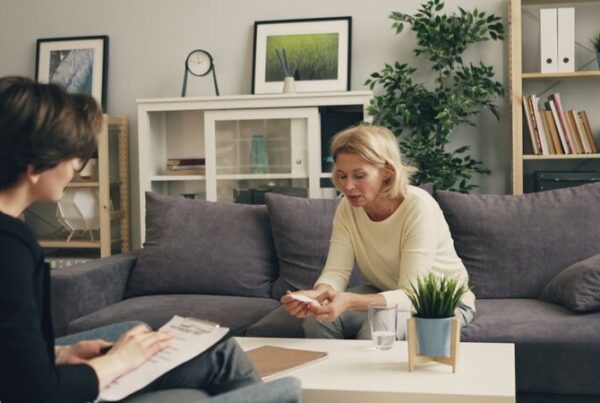
There is a sentence people in Ireland hear every year, usually in a quiet consulting room: “There is nothing more we can do for the eye.” It is meant kindly, and clinically it is often true. The trouble is that many people leave believing it means nothing more can be done at all. That is not the case.
Medicine treats the eye. Vision rehabilitation treats the life around it, and the gap between the two is where a great deal of unnecessary isolation happens. If you or someone close to you is losing vision in your 50s, 60s or 70s, here is what exists in Ireland and where to begin.
TL;DR
- Around 297,000 people in Ireland live with sight loss, and only about 5% are fully blind. Most have useful remaining vision worth learning to use.
- Vision Ireland (formerly the NCBI) provides free rehabilitation: independent living skills, mobility training, magnifiers and assistive technology. InfoLine 1800 911 250.
- Lighting, contrast and decluttering deliver more day-to-day benefit than any gadget, and cost very little.
- Entitlements include the Blind Pension (up to €254 a week from January 2026), the HSE Blind Welfare Allowance, the €1,950 Blind Person’s Tax Credit and a Free Travel Pass with companion pass.
- Seeing vivid images that are not there is common with sight loss. It is Charles Bonnet syndrome, not dementia or mental illness.
Sight loss is more common than most people assume
Vision Ireland puts the number of people living with sight loss or vision impairment in the country at roughly 297,000, and that figure climbs as the population ages. The most important detail in it is that only about one in twenty is blind in the everyday sense of the word. The majority have some usable vision, and the entire point of rehabilitation is to make that remaining vision go as far as it possibly can.
The common causes after 50 will be familiar: macular degeneration, glaucoma, cataract and diabetic retinopathy. What is less familiar is that a diagnosis does not automatically trigger a referral to support services. Most people have to ask.
The step most people miss: vision rehabilitation
Vision Ireland, which rebranded from the National Council for the Blind of Ireland in 2023, is the main national provider and its services are free. You do not need a GP referral; you can ring the InfoLine on 1800 911 250 yourself.
What it offers is more practical than the name suggests. Rehabilitation training covers independent living skills: cooking, labelling, managing money and running a household safely with reduced vision. Mobility training covers moving around confidently, including long cane technique. There is a low vision service for magnifiers and lighting advice, assistive technology training, and emotional support, because the psychological adjustment is real and rarely acknowledged.
Fighting Blindness runs Insight, a free and confidential telephone counselling service for people with sight loss and their families, on 01 674 6496. Irish Guide Dogs for the Blind in Cork provides guide dogs alongside independent living and mobility programmes. For people affected by both hearing and vision loss, the Anne Sullivan Centre specialises in deafblind support.
The home changes that do the heavy lifting
Rehabilitation officers tend to start with the environment rather than equipment, because it is cheap and the returns are immediate.
- Light, and a lot of it. Task lighting directly on the work, an adjustable lamp beside the reading chair, brighter bulbs throughout. Many people with macular degeneration need several times the light a younger eye requires.
- Kill the glare. Bright light helps; glare does not. Net curtains, matt surfaces instead of gloss and a wide-brimmed hat outdoors all reduce it.
- Contrast everywhere. A dark chopping board for potatoes and a pale one for meat. Coloured tape on the edge of each step. A toilet seat that differs in colour from the floor. These sound trivial and they change everything.
- Consistency. Things stay where they are put, doors stay fully open or fully closed, clutter comes off the floor. Trailing flexes and loose rugs are the usual culprits in falls.
Where structural changes are needed, the Housing Adaptation Grant for People with a Disability is administered through your local authority. Ask early, as processing takes time.
The technology is already in your pocket
Every current iPhone and Android phone ships with a screen reader built in (VoiceOver and TalkBack), along with magnification, high contrast modes and text enlargement. Free apps such as Seeing AI and Be My Eyes will read a letter aloud, identify a tin in the press, or connect you to a sighted volunteer by video.
For reading, Vision Ireland’s Library Access Service produces books in audio, braille, large print and digital formats, posted out freepost, and your local public library offers free audiobooks through BorrowBox. Nobody should have to give up reading because of sight loss, yet many quietly do because nobody told them these services exist.
If you see things that are not there
This one deserves its own section, because of the distress it causes. People with significant sight loss frequently experience vivid visual hallucinations: patterns, faces, figures, animals, brickwork. This is Charles Bonnet syndrome, and it happens because a visually deprived brain begins generating its own imagery. It affects a substantial minority of people with low vision, and more of those with advanced macular degeneration.
It is not dementia and it is not a psychiatric illness. The person knows the images are not real. It is badly under-reported, because people fear that describing it will be taken as evidence they are losing their mind. Telling your ophthalmologist or GP costs nothing, and understanding what it is reduces the fear considerably.
What you may be entitled to
These supports are genuinely useful and routinely under-claimed:
- Blind Pension: a means-tested Department of Social Protection payment, with a maximum personal rate of €254 a week from January 2026. It is paid up to age 66, at which point the State Pension takes over.
- Blind Welfare Allowance: a means-tested HSE supplement for people aged 18 and over, currently around €70 a week.
- Free Travel: Blind Pension recipients receive a Free Travel Pass and a Companion Pass, so someone travelling with you goes free too.
- Blind Person’s Tax Credit: €1,950 in 2026, or €3,900 where both spouses or civil partners are certified, plus a separate Guide Dog Allowance of €825 at the standard rate.
Certification by an ophthalmologist is generally required, and Vision Ireland’s advocacy team can help with the applications.
Look after the rest of you too
Sight loss raises the risk of falls, low mood and social withdrawal, and each compounds the others. Have your hearing checked, because combined hearing and vision loss is far more disabling than either alone and is easily missed. And protect the social calendar deliberately, because it is what quietly disappears first when getting out becomes harder.
Losing vision changes how you do things. With the right training and supports, it changes far less about what you can do than that quiet consulting room ever suggests. If you are unsure where to begin, one phone call to 1800 911 250 is the whole of the first step, and at Críonna Health we would rather you made it a year too early than a year too late.
This article is general information and is not a substitute for advice from your GP, optometrist or ophthalmologist.
📷 Photo by Manek Singh on Unsplash