If you’ve noticed it’s harder to carry the shopping in from the car, get up from a low chair, or open a stubborn jar these days, you’re not imagining it. From around our mid-30s — and accelerating after 50 — most adults steadily lose muscle mass and strength. The clinical term is sarcopenia, and while it’s a normal part of ageing, it’s not inevitable, and it’s far more reversible than most people realise.
Muscle isn’t just about looking strong. It’s central to balance, independence, blood sugar regulation, bone health, and recovery from illness or surgery. Here’s what older adults in Ireland need to know — and what research from the Irish Longitudinal Study on Ageing (TILDA) tells us about staying strong.
TL;DR
- Sarcopenia is the age-related loss of muscle mass, strength, and function — typically beginning in the 30s and accelerating after 60, with adults losing roughly 1–2% of muscle mass per year.
- It’s a leading cause of falls, frailty, and loss of independence, but resistance exercise and adequate protein can slow, halt, or even reverse it at any age.
- TILDA research shows that low muscle strength in Irish over-50s is strongly linked to higher risk of falls, hospitalisation, and earlier mortality.
- Aim for two strength sessions a week and around 1.0–1.2 grams of protein per kilogram of body weight daily — more if you’re recovering from illness.
- Free supports in Ireland include the HSE’s Sláintecare Healthy Communities programme, Active Retirement Ireland, and your GP via the Chronic Disease Management programme.
What sarcopenia actually is
Sarcopenia (from the Greek sarx, flesh, and penia, loss) is recognised by the World Health Organization with its own diagnostic code. It’s defined by three things: low muscle strength, low muscle mass or quality, and reduced physical performance.
From age 30, the average adult loses about 3–8% of muscle mass per decade. After 60, that loss can speed up to 1–2% per year. Strength declines even faster than mass — by some estimates two to five times faster — which is why you can feel weaker without looking dramatically different.
Why it matters more than people think
Muscle is metabolically active tissue. Losing it has knock-on effects across the body:
- Falls and fractures. The HSE estimates around one in three adults over 65 in Ireland will fall in any given year, and sarcopenia is one of the strongest modifiable risk factors.
- Loss of independence. Difficulty rising from a chair or carrying groceries can quietly progress to needing help with daily life.
- Slower recovery. Muscle reserves carry us through hospital stays, infections, and surgery.
- Type 2 diabetes risk. Skeletal muscle is the body’s largest site of glucose disposal — less muscle means poorer blood sugar control.
- Bone health. Sarcopenia and osteoporosis often travel together — sometimes called “osteosarcopenia”.
TILDA, based at Trinity College Dublin, has tracked muscle health in thousands of Irish adults over 50. Their data consistently shows that grip strength and the ability to rise from a chair without using your hands are powerful predictors of future health, hospital admissions, and even survival.
How to spot it early
Sarcopenia rarely announces itself. Signs worth flagging to your GP:
- You feel noticeably weaker carrying shopping or lifting a kettle.
- You struggle to stand from a low chair without using your arms.
- You walk more slowly than you used to, or feel less steady on your feet.
- You’ve lost weight without trying — particularly if clothes feel looser around the arms and legs.
A simple at-home test: time how long it takes to stand up from a chair five times in a row, with arms folded. Most healthy adults under 70 can do this in under 12 seconds. If it takes much longer, talk to your GP. Under the HSE’s Chronic Disease Management programme, GPs can refer patients to physiotherapy or community exercise initiatives.
The good news: muscle responds at any age
Here’s the part that surprises people most. Studies of adults in their 80s and 90s — including frail nursing-home residents — have consistently shown that muscle mass and strength can be rebuilt through resistance training. You don’t need a gym, lycra, or a personal trainer. You need progressive load and a bit of consistency.
1. Strength training, twice a week
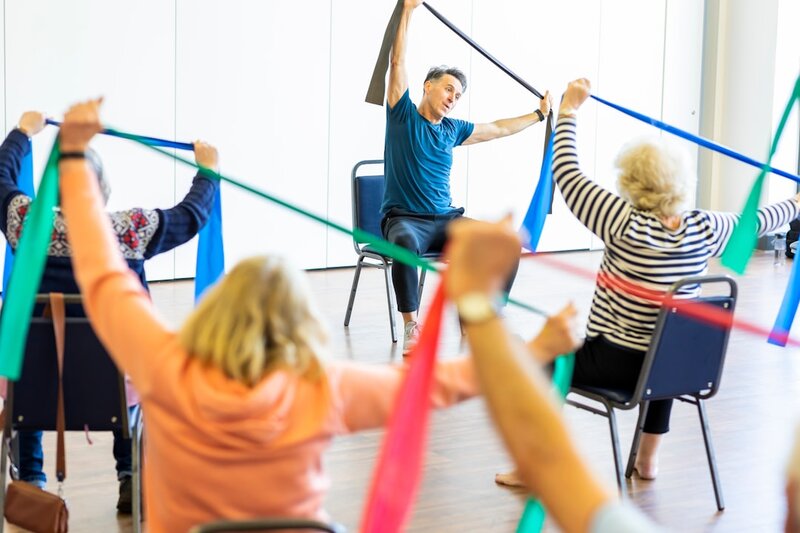
HSE guidelines, in line with WHO recommendations, advise adults of all ages to do muscle-strengthening activities on at least two days a week, working all major muscle groups. For older adults this might look like:
- Sit-to-stand exercises — repeatedly standing from a chair without using your hands.
- Wall press-ups — gentler than the floor variety, great for chest, shoulders, and arms.
- Resistance bands — inexpensive, joint-friendly, and surprisingly effective.
- Carrying loads — shopping, gardening, lifting grandchildren. Functional strength counts.
- Tai chi or yoga — particularly good for balance, posture, and the deep stabilising muscles.
The principle of progressive overload matters: if it stops feeling challenging, make it slightly harder.
2. Enough protein, spread through the day
Older muscle is somewhat resistant to building signals from food, so older adults actually need more protein than younger ones. Most experts recommend 1.0–1.2 grams per kilogram of body weight daily, rising to 1.2–1.5 g/kg if you’re recovering from illness.
For a 70 kg adult, that’s roughly 70–84 g of protein a day. Good sources include eggs, oily fish, dairy, beans and lentils, chicken, and tofu. Spreading protein across three meals — rather than loading it all into dinner — supports muscle synthesis better.
3. Vitamin D and the basics
Vitamin D supports muscle function, and Ireland’s grey skies make deficiency common. The HSE recommends a daily 15 microgram (600 IU) supplement for adults over 65 from October to March, and year-round if you’re housebound. Pair this with adequate hydration, sleep, and managing any long-term conditions.
Where to get help in Ireland
You don’t have to do this alone. Some of the best supports are free or low-cost:
- Your GP — for an assessment, physiotherapy referral, or the Chronic Disease Management programme.
- HSE Sláintecare Healthy Communities — free strength and balance classes locally.
- Active Retirement Ireland — over 500 local groups, many offering gentle strength sessions.
- Local Sports Partnerships — every county has one, many running “Go for Life” classes for older adults.
- SeniorLine (1800 80 45 91) — confidential listening service if you’re feeling overwhelmed.
The bottom line
Sarcopenia is one of the quieter changes of ageing — until it isn’t. The single most powerful thing you can do, at any age and any starting point, is ask your muscles to do something a little harder than they did yesterday, and feed them well. Two strength sessions a week, a bit more protein on your plate, and a willingness to keep moving will protect your independence in ways no supplement can match.
At Críonna Health, we believe ageing well is about staying capable, connected, and confident. If this article has prompted you to think differently about your strength, that’s a brilliant start.
This article is for general information only and is not a substitute for personalised medical advice. If you’re concerned about your strength, mobility, or recent falls, please speak to your GP.
📷 Photo by Centre for Ageing Better on Unsplash