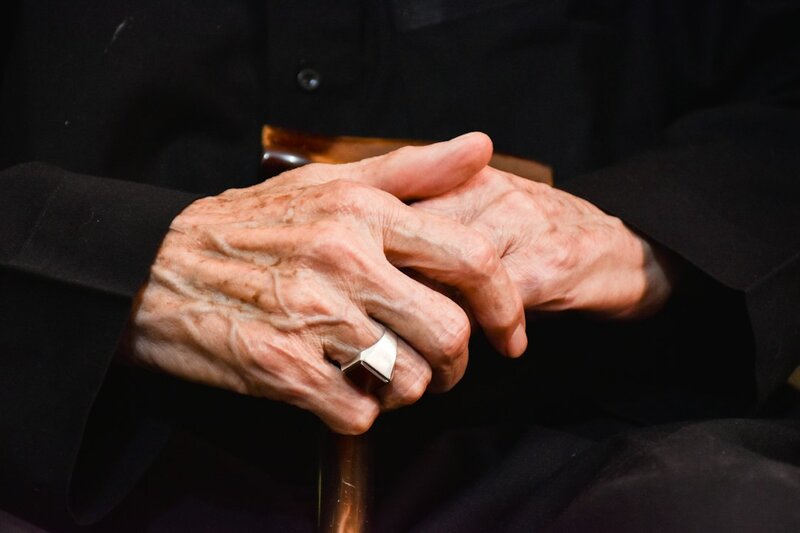
The story almost always gets told backwards. A man has carpal tunnel surgery on his right hand at 67, then the left at 69. At 71 his lower back starts to seize up when he walks, and a spinal surgeon sorts it. At 76 he is breathless on the stairs, his ankles swell, and a cardiologist tells him his heart muscle has thickened.
Three problems, three specialists, nine years. Only at the end does anyone draw a line through them. The line has a name: transthyretin amyloid cardiomyopathy, usually shortened to ATTR-CM. It matters now because Ireland funds two medicines that slow it down, and both come with eligibility rules that get harder to meet the longer the diagnosis takes.
TL;DR
- ATTR cardiac amyloidosis is a build-up of misfolded protein that stiffens the heart muscle. It mostly affects men over 70 and is routinely mistaken for age-related heart failure.
- It announces itself years early in the hands, shoulders and lower back. Carpal tunnel syndrome in both hands typically arrives 5 to 10 years before any heart symptoms.
- Most cases are now diagnosed without a biopsy, using blood tests, an echocardiogram and a bone scan.
- Ireland reimburses tafamidis (since March 2022) and acoramidis (added December 2025) under an HSE Managed Access Protocol.
- The funding rules exclude people whose heart failure has reached the most severe band, so a late diagnosis can cost you the treatment as well as the time.
What is actually happening
Transthyretin is an ordinary protein made by the liver, travelling in the blood as a neat bundle of four units. With age, that bundle becomes more likely to come apart. The loose pieces misfold, clump together as amyloid fibrils, and settle into tissue where they do not belong. When they settle in the heart, the walls thicken and go stiff.
This is not a weak pump, which is the picture most people have of heart failure. It is a heart that has lost the ability to relax and fill properly between beats. Output drops because less blood goes in, not because less is pushed out, which is why the ejection fraction on an echocardiogram can look reassuringly normal while someone becomes steadily more breathless. In most people there is no genetic cause at all: this is simply what ageing does to the protein. In a large Italian study published in 2025, 95% of cases were this wild-type form.
Rare is the wrong word
ATTR-CM spent decades classified as rare, largely because it was mostly found at post-mortem. The CAPTURE study, published in the European Journal of Heart Failure in 2025, recruited 1,215 people aged 65 and over across six Italian centres. Everyone enrolled had a history of carpal tunnel syndrome plus either heart failure or a thickened left ventricle, and nobody had a prior amyloid diagnosis. Twenty-six per cent turned out to have ATTR-CM. The yield was 41% where the heart muscle was thickened and 14% where there was heart failure without thickening.
That was a deliberately high-risk group, and the figure does not transfer to the general population: screening unselected people aged 65 to 90 found a prevalence under half a per cent. The message is narrower than a headline. If you have had carpal tunnel surgery and you now have a thickened heart muscle, the odds of this being amyloid are not small at all.
The signals that arrive a decade early
Transthyretin does not go to the heart first. It goes to ligaments and tendons, which is why the earliest evidence tends to land on an orthopaedic surgeon’s desk rather than a cardiologist’s. Roughly 80% of people later diagnosed with ATTR-CM have had orthopaedic procedures on hips, knees or shoulders, on average 4 to 10 years before any cardiac symptoms. Carpal tunnel syndrome, usually in both hands, runs 5 to 10 years ahead. A biceps tendon that ruptures spontaneously, leaving the lump sometimes called a Popeye deformity, typically precedes the heart diagnosis by about five years. In people having surgery for narrowing of the lower spine, transthyretin deposits have been found in the ligamentum flavum in up to a third of cases.
Taken one at a time, every one of these is unremarkable in your sixties and seventies. Hands get numb, backs narrow, tendons wear out. The signal is not any single item, it is the cluster. A few other things belong on the same list: blood pressure tablets you suddenly no longer seem to need, atrial fibrillation appearing from nowhere, tingling in the feet. Our guides to hand and wrist health after 50 and sciatica and lower back nerve pain cover the individual pieces.
Why it takes so long
Median delay from first symptoms to diagnosis runs at about 3.4 years for the wild-type form, with reported misdiagnosis rates between 34% and 57%. In a large American study of people diagnosed between 2016 and 2022, each additional year of delay carried a 7% higher risk of heart failure hospitalisation or death. Without treatment, median survival after diagnosis sits somewhere between two and six years. This is not a condition where waiting is neutral.
The Donegal variant
Ireland has a particular stake in this. A change in the TTR gene known as T60A, and more recently as T80A, was first traced to north-west Donegal, and experts have estimated that around 1% of the population along a stretch of that coastline may carry it. Known locally as Donegal Amy, it travelled with emigration to Britain and to the Appalachian region of the United States, and is now one of the most common TTR variants seen across Ireland and the UK. Symptoms usually begin between 45 and 80, most often after 60, and can involve the nerves as well as the heart.
So if you have Donegal ancestry and unexplained heart or nerve symptoms, say so out loud at the appointment: family origin is a genuine clinical clue here. But the hereditary form is not the usual story, and for most Irish people over 70 who develop this there is no inherited risk to pass on. That is why anyone confirmed to have ATTR-CM should have TTR gene sequencing, since only the hereditary form raises questions for adult children and siblings. A best-practice consensus covering Ireland and the UK recommends families be offered genetic counselling alongside the result.
How you actually get tested in Ireland
The first stretch of the pathway now sits with your GP, which is a meaningful change. Under the HSE’s direct access arrangements, a GP can order an NT-proBNP blood test, a marker of strain on the heart, and then refer straight for an echocardiogram without going through a hospital clinic. The thresholds are specific. For someone with signs and symptoms of heart failure, an NT-proBNP above 400 pg/ml supports a routine echo referral, averaging around six weeks. Above 2,000 pg/ml it becomes urgent, averaging about two weeks, alongside specialist review. The service is free and open to all adults aged 16 and over, whether or not you hold a medical card.
If the echo shows thickened heart walls, the next steps happen in a specialist centre, and three things need to line up. A different and more serious form of amyloidosis caused by a blood disorder has to be ruled out with blood and urine protein tests. A bone scan using a tracer such as DPD or PYP shows whether the heart is taking it up. Genetic testing establishes wild-type or hereditary. With a strong scan and the blood disorder excluded, no heart biopsy is needed: in CAPTURE, 84% of diagnoses were made this way.
Treatment, and the window that closes from both ends
Two medicines are reimbursed in Ireland for ATTR-CM, both taken by mouth, both working by holding the transthyretin bundle together so it stops shedding the pieces that form amyloid. Tafamidis (Vyndaqel) has been available on the High Tech Arrangement since 1 March 2022. Acoramidis (Beyonttra) was added on 1 December 2025.
In its pivotal trial, tafamidis cut deaths over 30 months from 42.9% to 29.5%, a relative reduction of about 30%, and reduced cardiovascular hospitalisations by roughly a third. Acoramidis showed 30-month survival of 81% against 74% on placebo. Neither reverses damage already done. Both slow what happens next, which is precisely why timing decides how much they are worth.
Access runs through an HSE Managed Access Protocol, and the detail is worth knowing in advance. Applications can only come from cardiologists who have signed up to the protocol and been approved by the HSE, and each patient needs an individual application. Eligibility runs from age 18 to 90 and requires a documented diagnosis: the blood disorder excluded, a positive scan or biopsy, a septal wall thickness above 12 mm, a history of heart failure, and a confirmed TTR genotype.
Then come the exclusions, and this is the part that should concentrate minds. Reimbursement is not supported for people whose heart failure symptoms have reached New York Heart Association class IV, the most severe band, nor where kidney function has fallen below an eGFR of 25. Treatment should be stopped, with funding withdrawn, if someone already taking it progresses to class IV.
Read that alongside the diagnostic delay figures and the shape of the problem becomes clear. The window opens when you are unwell enough to have a documented heart failure history, and it closes when you become too unwell to qualify. Years spent working through one specialist at a time are years spent crossing that window without anyone noticing.
Cost gives a sense of the stakes: a month’s supply lists at €9,180 for Vyndaqel and €8,856 for Beyonttra, though the HSE negotiates confidential discounts. Once approved, the medicine is dispensed through a community pharmacy, so medical card holders pay the standard prescription charge and everyone else can cap monthly outlay through the Drugs Payment Scheme at €80.
One further point for anyone already diagnosed: the standard drug regime for other kinds of heart failure does not transfer neatly to amyloid hearts. That is a conversation for a cardiologist familiar with the condition, not a reason to change anything yourself. Our guide to heart failure after 50 covers the general ground.
What to raise with your GP
- List the orthopaedic history in one go: carpal tunnel in both hands, a ruptured biceps tendon, spinal narrowing, hip or shoulder work. Together rather than one visit at a time, it reads as a pattern.
- If you are breathless, ask whether an NT-proBNP test is appropriate and what the result would mean for an echocardiogram referral.
- If an echo has already shown thickened heart walls and the cause was put down to blood pressure, ask whether amyloidosis has been ruled out.
- Mention blood pressure medication you have been able to reduce or stop, and any new atrial fibrillation. Both are easy to read as good news.
- If you have north-west Donegal ancestry and unexplained heart or nerve symptoms, say so.
Where to get support
The Irish Heart Foundation runs a free Nurse Support Line on 01 668 5001, open 9am to 5pm on Mondays and 9am to 1pm Tuesday to Friday, along with peer support for people living with heart failure. Croí offers heart and stroke support services in the west. HSE Live can be reached on 1800 700 700 for questions about schemes and entitlements. Amyloidosis Ireland (amy.ie) is a volunteer advocacy group running awareness work and private peer support groups for patients and families across the island.
At Críonna Health we write about the conditions filed under ageing when they deserve a name of their own. This is one of them. A heart stiffened with amyloid is not the same thing as a heart that has simply grown old, the difference is now treatable, and the evidence was in someone’s hands a decade before anyone thought to look at their heart.
This article is for information only and is not a substitute for individual medical advice. If you are breathless, swelling, or worried about your heart, speak to your GP. Call 999 or 112 for chest pain or sudden severe breathlessness.
📷 Photo by أخٌفيالله on Unsplash




