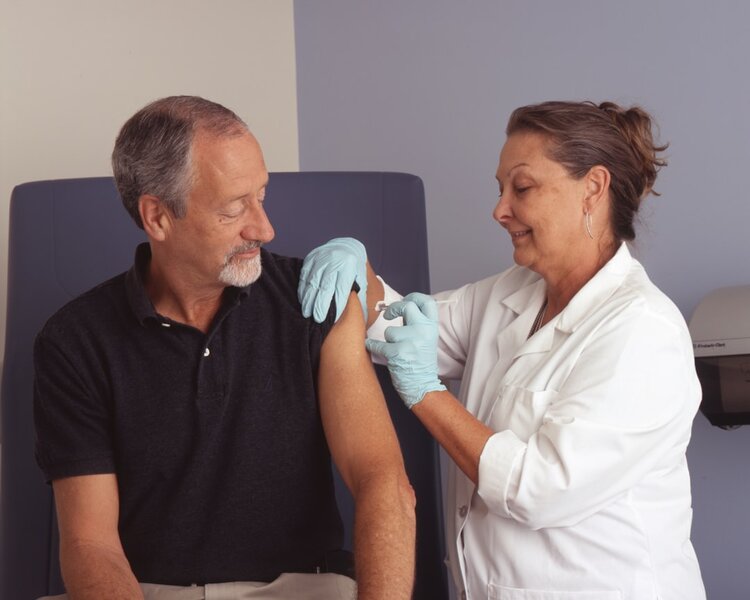
Every autumn the flu message sounds the same, so most people stop hearing it. This year it is worth listening again, because for anyone aged 65 and over the vaccine in the fridge at your GP surgery or pharmacy is not the one you were given last winter.
Ireland’s 2026/27 seasonal influenza programme brings back an enhanced vaccine for older adults after a season without one. Underneath it sits a quieter change: the national advisory committee now recommends an annual flu vaccine from the age of 50, while the free programme still begins at 60.
TL;DR
- Adults aged 65 and over are offered Fluad this season, an adjuvanted vaccine designed to produce a stronger immune response than the standard jab.
- NIAC now recommends annual flu vaccination for everyone aged 50 and older, but the HSE-funded free vaccine still starts at 60 unless you are in an at-risk group.
- Last winter was not a mild one: 291 flu deaths, 201 ICU admissions, and a notification rate of 2,365 per 100,000 among people aged 80 and over.
- Uptake among over-60s reached 66.1 per cent, still short of the 75 per cent national target.
- Antibodies take 10 to 14 days to reach protective levels, so September and October are the useful months, not December.
What is actually different this season
Under the HSE letter to vaccinators issued on 28 August 2026, four influenza vaccines are in use this season. People aged 65 and over are given Fluad, an adjuvanted inactivated vaccine. Adults aged 60 to 64, and eligible adults aged 18 to 59, receive a standard inactivated vaccine, either Influvac or Vaxigrip. Children aged 2 to 17 get the Fluenz nasal spray.
The Fluad line is the change. The National Immunisation Advisory Committee (NIAC) has recommended an adjuvanted vaccine for the over-65s for some time, but in the 2025/26 season the HSE did not supply one, offering the standard vaccine instead on cost-effectiveness grounds. A HIQA health technology assessment published in October 2024 had found adjuvanted and high-dose vaccines more effective than standard ones at preventing flu and flu-related hospitalisation in people aged 65 and older, while stressing that a switch only made financial sense at the right price. This season, the price evidently worked.
Why an adjuvant matters after 65
An adjuvant is an added ingredient, in this case MF59, whose job is to provoke a bigger immune response to the same viral antigens. It exists because of a well-documented problem: the immune system responds less vigorously to vaccines as we age. NIAC notes that protection is lower in older and immunocompromised people, while being equally clear that vaccination still significantly reduces illness and death in exactly those groups. Lower is not the same as pointless. This is the same gradual shift in immune function that makes infections hit harder in later life.
There is a modest trade-off: mild, short-lived local reactions, chiefly a sore arm, are reported more often with adjuvanted vaccines than with non-adjuvanted ones. Serious reactions remain rare. You do not get to choose between products, so the value in knowing this is simply that a heavier arm for a day or two is expected rather than alarming.
The ten-year gap between 50 and 60
NIAC updated its influenza guidance on 3 July 2026, and it now recommends annual influenza vaccination for all adults aged 50 years and older. The HSE’s funded programme, meanwhile, offers the free vaccine from 60. So if you are 53 and otherwise well, the national expert committee thinks you should have a flu vaccine every year, and you will be paying for it yourself. Ask your pharmacy the price before assuming it is out of reach.
The more useful point for people in their 50s is that many are already entitled to it free and have never checked. The at-risk list covers chronic heart, kidney, liver, neurological or respiratory disease, diabetes and other metabolic disorders, cancer, immunocompromise, haemoglobinopathies, a BMI over 40, serious mental health conditions and Down syndrome. Two routes get missed most often: carers, and anyone living in the same household as a person at increased risk. If your husband has COPD or your mother has diabetes and you do her shopping, you qualify.
Who gets it free, and what to bring
The state-funded vaccine is free this season for everyone aged 60 and over, all children and young people aged 2 to 17, anyone aged six months and over in the at-risk groups above, adults living in residential care and other long-stay facilities, healthcare workers, pregnant women at any stage of pregnancy, carers and household contacts of at-risk people, and those in close regular contact with pigs, poultry or waterfowl.
Bring your PPS number to the appointment. You can be vaccinated by your GP or by a participating pharmacist, and if you are due a COVID-19 booster, NIAC advises giving both on the same visit where practicable. Two arms, one trip. An RSV vaccine, if you are eligible, can be co-administered too.
Why the timing genuinely matters
NIAC’s advice is that the ideal time is September or October, although the vaccine can be given until the end of April. Last season’s programme opened on 15 September and this season’s is expected in late September, so it is worth ringing ahead rather than waiting for a reminder.
Two numbers explain the urgency. Influenza antibodies take 10 to 14 days to reach protective levels, and vaccine-induced immunity may begin to wane three to five months afterwards. That window is why the advice is autumn rather than midsummer, and also why going in December is late but still worthwhile.
What last winter actually looked like
The 2025/26 season was driven by a newly emerged and drifted influenza A(H3) subclade K virus. The overall notification rate was 483 per 100,000, but among people aged 80 and over it reached 2,365 per 100,000. There were 201 influenza-related ICU admissions and 291 deaths. Between 80 and 90 per cent of reported influenza deaths occur in older people, and the serious damage is often indirect: pneumonia, bacterial co-infection, or a heart or lung condition tipped over by a week of fever.
Uptake is climbing slowly. By mid-January 2026, 66.1 per cent of adults aged 60 and over had been vaccinated, up from 62.4 per cent the season before, against a target of at least 75 per cent. Nursing home residents were well covered at 83 per cent; HSE healthcare workers sat at 34 per cent.
The two things people get wrong
The first is the belief that the vaccine causes flu. It cannot. The injected vaccines used in adults contain inactivated virus, and NIAC states flatly that inactivated vaccines cannot cause influenza. What people usually experience is a sore arm and a day of feeling off, which is an immune system doing its work. What they sometimes experience is bad luck: the incubation period for flu is one to four days, so a virus picked up in the surgery car park announces itself right around the time the jab gets blamed.
The second is assuming last year’s vaccine still counts. Immunity wanes, circulating strains drift, and the composition changes. For 2026/27 the WHO has recommended trivalent formulations, dropping the B/Yamagata component because that lineage has not been detected since March 2020.
What to do this week
- If you are 65 or over, ring your GP or pharmacy and ask when Fluad appointments open.
- If you are 60 to 64, book the standard vaccine and ask for your COVID-19 booster at the same visit.
- If you are in your 50s, check the at-risk and carer lists before assuming you have to pay.
- Have your PPS number to hand when you book.
- If someone at home is aged 80 or over, get yourself vaccinated too. Household contacts are a documented route into the house.
This year the state has put a better vaccine behind the counter for people over 65. It only works if someone rolls up a sleeve.
Críonna Health publishes practical, evidence-informed guidance on ageing well in Ireland. Nothing here replaces advice from your GP or pharmacist.
📷 Photo by National Cancer Institute on Unsplash