We picture cardiac arrest as something that happens in public: a football pitch, a shopping centre, a crowd parting. The Irish figures tell a quieter story. In the National Ambulance Service’s most recent Out-of-Hospital Cardiac Arrest Register (OHCAR) report, 68 per cent of cardiac arrests happened in the home, and the median age of the person affected was 68.
So the person most likely to be there when a heart stops is not a paramedic. It is a husband, an adult daughter, a neighbour who called in for tea. That is an uncomfortable thought, and a hopeful one, because bystanders are the single biggest variable in whether someone lives.
TL;DR
- 68 per cent of out-of-hospital cardiac arrests in Ireland happen at home, median age 68, so the likely first responder is family, not a professional.
- A cardiac arrest is not a heart attack. The person is unconscious and not breathing normally. Gasping is not breathing.
- Three steps: recognise, ring 112 or 999, push hard and fast on the chest. The call taker talks you through it, so you do not need training to start.
- Ireland has roughly 9,000 defibrillators and no law requiring anyone to register them, so thousands are invisible to ambulance dispatchers.
- Free CPR training exists through the Irish Heart Foundation’s Hands for Life programme, under an hour, for groups of 30 or more.
A cardiac arrest is not a heart attack
Confusing the two costs minutes. A heart attack is a plumbing problem: an artery to the heart muscle blocks, and the person is usually awake, in pain and able to talk to you. A cardiac arrest is an electrical problem. The heart stops pumping, the person collapses, does not respond, and is not breathing normally. A heart attack can trigger a cardiac arrest, but the two need very different responses.
The detail that trips people up is agonal breathing: irregular, noisy, gulping gasps that can continue for a minute or two after the heart stops. It looks like breathing, and families have waited for the ambulance because “he was still breathing”. If someone is unresponsive and their breathing is anything but normal and regular, treat it as a cardiac arrest and start.
What the Irish numbers show
OHCAR is hosted and funded by the National Ambulance Service. Its 2024 report recorded 2,885 people who had an out-of-hospital cardiac arrest where resuscitation was attempted. Of those, 232, or 8.0 per cent, survived to leave hospital alive.
Eight per cent sounds bleak until you look at what happens when a bystander gets involved. Members of the public defibrillated 339 patients in 2024, and 90 survived: 27 per cent, against roughly one in twelve overall. Research on Irish cases from 2012 to 2020 found bystander CPR associated with a 57 per cent increase, and bystander defibrillation a 78 per cent increase, in the adjusted odds of surviving to discharge. The gap between eight and twenty-seven per cent is what is still on the table.
The first ten minutes
The Irish Heart Foundation reduces it to three things, in this order.
Recognise it. Unresponsive, not breathing normally. Do not wait to be certain. The cost of starting CPR on someone who did not need it is embarrassment.
Ring 112 or 999 and put the phone on speaker. Ambulance control will talk you through compressions in real time. You do not need a certificate, you need a phone on the floor and someone in your ear counting.
Push hard and fast in the centre of the chest. About twice a second, letting the chest come all the way back up between compressions. For an untrained bystander, compressions alone are enough. Skip the rescue breaths and keep pushing.
If anyone else is there, send them for the nearest defibrillator while you stay and compress. People hesitate over cracked ribs, which does happen and heals, or over doing it wrong. The alternative to imperfect CPR is almost never perfect CPR. It is no CPR at all. And if a defibrillator arrives, use it: it talks you through every step and will not shock a heart that does not need it.
Ireland’s defibrillator blind spot
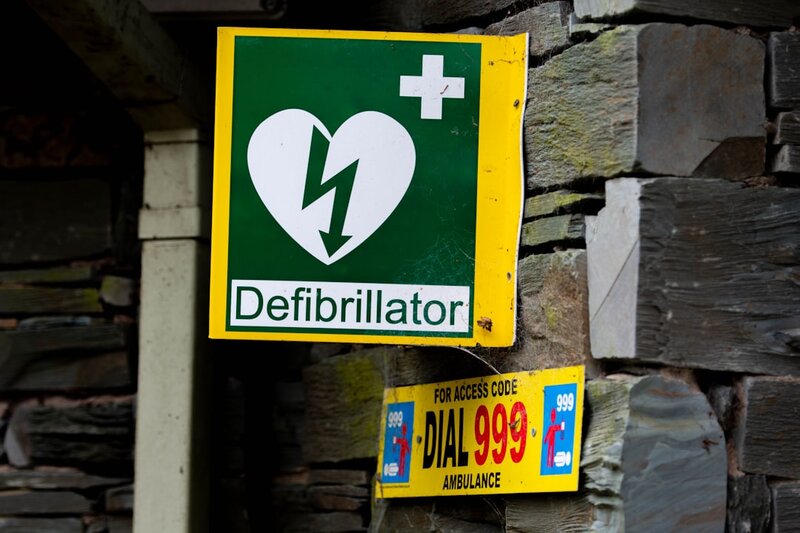
There are an estimated 9,000 AEDs around the country, in parish halls, GAA clubs, hotels and housing estates, most locally fundraised. But there is no national legislation on defibrillators in Ireland and no obligation to tell anyone where yours is. Thousands are missing from the ambulance service’s database, and a dispatcher who cannot see a defibrillator cannot send you to it.
The National Ambulance Service runs the National AED Network to gather this information, and has appointed a coordinator to manage it. If you have responsibility for a defibrillator through a club, a business or a residents’ association, register it: free, and it takes minutes. Then check the pads and battery, because a registered defibrillator that will not fire is no better than an unregistered one.
The volunteers who often arrive first
Community First Responder groups have operated here for around twenty years. Over 3,000 volunteers now cover more than 250 communities, dispatched by the same 999 and 112 ambulance control that sends the ambulance, and in rural areas they often arrive first because they live closer. They are trained in CPR and AED use, in recognising stroke and heart attack, and in relief of choking. Most have no medical background. Details are at becomeacfr.ie and cfr.ie. Retirement tends to free up exactly what these schemes are short of: people who are home during the day and know which house is which.
Where to learn, and what it costs
Nothing, through Hands for Life, set up by the Irish Heart Foundation in 2019 with support from Abbott and ESB Networks. A session runs just under an hour and covers recognising a cardiac arrest, compressions on a manikin, AED use, choking and stroke. Groups of 30 or more can arrange a free session by ringing 01 668 5001 or emailing [email protected]. Active retirement associations, men’s sheds, parish groups and workplaces are natural hosts.
The conversation nobody wants
Attempted resuscitation is not the right outcome for everyone. For someone living with advanced illness or significant frailty, CPR can cause real harm without a realistic prospect of recovery, and deciding against it is not giving up. It is a judgement best made calmly with a GP or consultant well in advance, and written down.
Ireland’s framework sits under the Assisted Decision-Making (Capacity) Act 2015, which lets you record your wishes about future treatment, including resuscitation, while you still have capacity. We have covered advance healthcare directives separately. This belongs at a kitchen table on an ordinary Tuesday, not improvised by a distraught family at three in the morning.
Five things worth doing this month
- Find the nearest defibrillator to your home and check it is registered with the National Ambulance Service.
- Write your Eircode somewhere visible near the phone. The caller may not be you.
- Book a free Hands for Life session for a group you belong to.
- If you look after an AED, register it and check the pads and battery today.
- Tell the people you live with the three steps: recognise, ring, push.
None of this asks you to become a medic. It asks you to be the person who does not freeze in a sitting room in the four minutes before help arrives.
Críonna Health publishes practical, evidence-informed guidance on health and ageing in Ireland. Nothing here replaces advice from your GP or the emergency services.
📷 Photo by Richard Bell on Unsplash