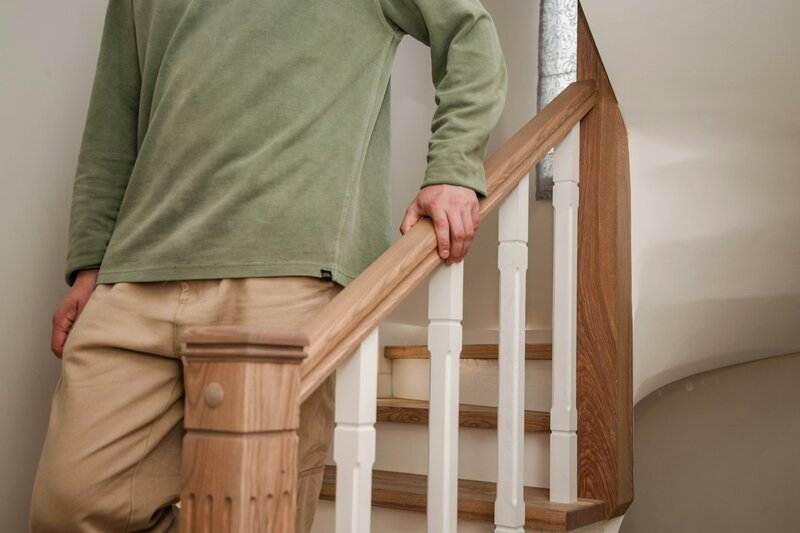
Almost everything written about falls is written about the fall: the loose rug, the bad lighting, the blood pressure tablet that drops you when you stand up too quickly. All of it matters. But ask an ambulance crew in Ireland what they actually find when they arrive, and often the fall is the least of it. The person is not badly hurt. They have simply been on the floor since half nine last night.
Geriatric medicine has a plain name for this: the long lie. It means lying on the floor for an hour or more after a fall because you could not get up and nobody came. It is one of the most serious things that can happen to an older person at home, it is far more common than families imagine, and almost nobody plans for it.
TL;DR
- A “long lie” means an hour or more on the floor after a fall, and it carries risks of its own: muscle breakdown that injures the kidneys, pressure damage, dehydration, hypothermia and chest infection.
- In a BMJ study following people aged over 90 for a year, 80% of those who fell could not get up unaided after at least one fall, and 30% had spent an hour or more on the floor.
- Alarms were widely available in that study and rarely used. Of the long lies that happened to someone with an alarm installed, 97% involved an alarm that was never pressed.
- Irish research published in February 2026 found almost one in three people aged 70 and over had fallen in the previous year. Ireland still has no national falls prevention strategy.
- Two things help most: learning to get yourself up off the floor, and a way to call for help that you actually wear. The Seniors Alert Scheme funds the second for eligible people aged 65 and over.
What an hour on the floor does to a body
Lying still on a hard surface is not neutral. Muscle under sustained pressure starts to break down and release its contents into the bloodstream, a condition called rhabdomyolysis, and the kidneys do not cope well with filtering it. In older adults, a long lie after a fall is one of the commonest causes: a study in BMC Geriatrics of 343 older patients admitted with rhabdomyolysis found acute kidney injury in 58% of them. Alongside that sit pressure damage to skin over hip, shoulder and heel, dehydration, chest infection from lying flat for hours, and hypothermia, which is a real risk in an Irish house in November on a tiled kitchen floor with the heating off overnight.
The long-term data is older and thinner. A small 1981 BMJ study followed 125 people aged 65 and over who fell at home; twenty lay on the floor for more than an hour, and half of that group died within six months. A long lie is partly a marker of how frail someone already was, not purely a cause of what came after. Either way, if someone you love has spent an hour on the floor, that is a significant event in their health, broken bone or no broken bone.
How often it happens, and the alarm nobody presses
The best evidence comes from a 2008 BMJ study by Jane Fleming and Carol Brayne, who followed 110 people aged over 90 for a full year and recorded every fall as it happened. There were 265 falls, and in 82% the person was alone. Of those who fell, 80% could not get up unaided after at least one fall, and 30% had lain on the floor for an hour or more. Long lies were strongly associated with serious injury, hospital admission and a move into long-term care afterwards. That was a very old cohort and the figures would be lower at 70, but the driver is strength rather than age: getting up off the floor is a hard physical task, and leg power and confidence both erode quietly unless something is done about it.
Then comes the finding that is hard to forget. Call alarms were nearly universal in that group. In 99% of the falls where someone was alone and could not get up, there was an alarm system in the house. In 80% of those falls it was not used, and of the falls that became a long lie despite an alarm being installed, 97% involved an alarm that was never activated. Virtually nobody who pressed their alarm spent more than an hour on the floor. The technology works. The wearing and the pressing is where it falls down.
The reasons people gave are painfully recognisable. Some had never got into the habit of wearing the pendant. Some could not reach it, or were outdoors and assumed it would not work there. And some decided against it. One woman, who spent fifteen minutes shuffling from the bathroom to an armchair she could haul herself up on, explained: “I didn’t want to use the call alarm, although I was wearing it, for fear of being taken into hospital.” That is not stubbornness. It is a calculation by someone who knows what an unplanned admission can do to a person’s independence.
The Irish picture
In February 2026, researchers at TILDA in Trinity College Dublin published the DEFINED study in BMJ Open, analysing 2,299 people aged 70 and over. Almost one in three had fallen in the previous year, one in eight had a fall needing medical attention, roughly 62,000 people nationally, and one in sixteen ended up in an emergency department. The structural findings are worse: Ireland has no national falls prevention strategy, no primary care pathway for a proper multifactorial assessment, and more than one in five older people cannot access a dedicated falls clinic at all.
Set that against how we live. Census 2022 found more than one in four people aged 65 and over living alone, rising to 44% of those aged 85 and over. Living alone is not a problem in itself, and for many people it is exactly what they want. It simply changes the maths after a fall. Nobody is coming in at teatime to find you.
The Seniors Alert Scheme, in practice
Ireland funds the answer to this. The Seniors Alert Scheme provides a free monitored personal alarm, worn as a pendant or on the wrist, to people aged 65 and over with limited means who live alone, live alone for significant parts of the day, live with another person over 65 of limited means, or care for someone in the household.
Equipment and installation are free, and monitoring is free for the first year. After that there is an annual fee, often around €70 depending on the provider, plus a SIM charge if there is no landline and the unit connects over a mobile signal. Pressing the button rings a helpline staffed 24 hours a day, all year; an operator speaks to you through the base unit and decides whether to send a local volunteer responder or the emergency services. One point catches people out: you cannot apply yourself. Pobal only accepts applications from registered community and voluntary groups, so contact a registered group in your area and they apply on your behalf. A family member or neighbour can do it for you, and the list of groups by county is on pobal.ie.
Two warnings. A pendant in a drawer is a pendant that does not exist, so build the habit on day one. And Ireland’s old copper phone network is being retired area by area, so if your alarm dials out over a landline, tell the monitoring company before you change phone or broadband provider, and test the alarm afterwards.
Learn to get up off the floor
This is the part that gets skipped, and the part you control. Getting up from the floor is a skill, it can be taught, and it can be practised long before you need it. The usual sequence is to roll onto your side, push up onto hands and knees, crawl to something solid like an armchair, put both hands on the seat, bring your stronger leg into a kneeling lunge, then push up and turn to sit. Do not learn it from a paragraph. Ask your GP for a referral to community physiotherapy, or see a chartered physiotherapist privately, and have someone watch you do it. The same session should cover leg strength work, because that is what makes the manoeuvre possible at all.
If you cannot get up, the priorities change. Drag yourself off cold tile onto carpet if you can, pull down a coat or cushion, shift position every half hour to take the pressure off one hip, and keep moving your arms and legs. Make noise: bang on a wall or a radiator, or shuffle towards a door. This is the real argument for keeping a mobile phone in a pocket rather than on the hall table.
A fall you could not get up from is a reason to be assessed
The World Falls Guidelines list inability to get up from the floor as a trigger for a full multifactorial falls risk assessment, on the same footing as an injurious fall or two falls in a year. Most people never mention it to their GP, because nothing was broken and it feels embarrassing rather than medical. Mention it. It changes what should happen next, including a medication review: almost half of the Irish participants who had a fall needing medical attention were taking at least one drug known to increase falls risk.
Worth knowing too is the National Ambulance Service Pathfinder service, which pairs an advanced paramedic with an occupational therapist or physiotherapist to answer 999 and 112 calls from people aged 65 and over, treat them at home where that is safe, and follow up afterwards with equipment and rehabilitation. It is not nationwide, but it covers a growing number of areas including Dublin, Cork, Limerick, Waterford, Galway, Kerry, Donegal and Carlow/Kilkenny. ALONE’s national support line on 0818 222 024 is open 8am to 8pm every day and can link people into local supports, including help with a Seniors Alert Scheme application.
The conversation to have this week
At Críonna Health we spend a lot of time on prevention, and prevention is right. But prevention is never complete, and the honest planning question is not “how do we make sure you never fall”. It is “if you go down in the kitchen at ten at night, how long before somebody knows”. If the answer is “not until the carer comes tomorrow”, that is the thing to fix. Not with a lecture, and not by taking anything away. With an alarm that gets worn, a phone that stays in a pocket, and an afternoon with a physiotherapist learning how to get up.
This article is for general information and is not a substitute for medical advice. If you have fallen, or have found it difficult to get up after a fall, speak to your GP.
📷 Photo by Pavel Egorov (@pavel3g) on Unsplash




