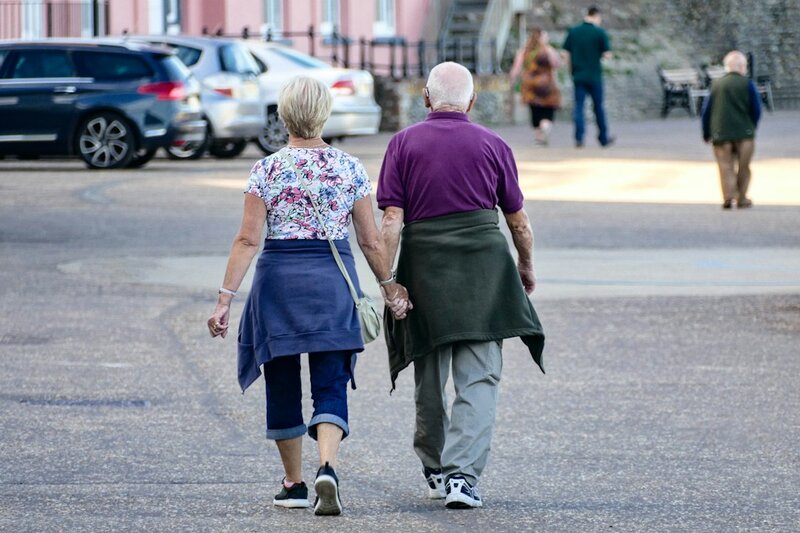
The clocks go back on Sunday 25 October, and with them goes the bright half of the Irish day. For anyone who walks to the shop, to Mass, to the bus stop or simply for the good of their heart, the next five months mean sharing the road with traffic in poor light. Walking is the single most recommended activity for health after 50, and rightly so. The bit nobody plans for is the road itself.
There is an uncomfortable pattern buried in the Irish casualty figures, and it is not the one most people expect.
TL;DR
- People aged 65 and over make up roughly one in seven injured pedestrians in Ireland, but around four in ten pedestrians who are killed. The difference is survivability, not carelessness.
- Irish pedestrian lights assume a walking speed of 1.2 metres per second. TILDA research found that 31% of Irish adults aged 65 to 74 and 61% of those aged 75 and over walk slower than that.
- Walking while holding a conversation slows you further. In the same study, 91% of adults aged 75 and over could not make the crossing time while dual tasking.
- Around two thirds of fatal pedestrian collisions happen in darkness, and the October to December window is the worst of the year.
- Speed limits are falling: rural local roads dropped to 60 km/h in February 2025, and councils are rolling 30 km/h limits into urban cores and housing estates by March 2027.
- A sight test, a medication review and a pair of decent shoes are road safety measures. So is a high-visibility vest, which the RSA gives away free.
The number that should change how you think about this
Take the most recent full year of CSO road casualty data. Of 1,274 pedestrians injured on Irish roads, 193 were aged 65 or over. That is about 15%, almost exactly the share of the population that age group represents. Older adults are not being struck by cars any more often than anyone else.
Now look at the deaths. Of 43 pedestrians killed that year, 17 were aged 65 or over. That is 40%. The year before was starker still: 22 of the 42 pedestrians killed in Ireland, more than half, were 65 or over.
Read those two figures side by side and the story tells itself. The same collision, at the same speed, on the same stretch of road, is far more likely to be fatal after 65. This is not about carelessness near traffic. It is about what a human body can absorb.
Why the same impact does more damage
Bone density falls with age, the chest wall becomes less flexible, and the internal cushioning that protects organs thins out. Research from the AAA Foundation quantified it neatly: the risk of death for a 70-year-old pedestrian struck at a given speed is roughly the same as for a 30-year-old struck by a car travelling about 17 km/h faster. A 30 km/h impact at 70 carries the risk that a 30-year-old would face at closer to 50 km/h.
Recovery is the other half of it. A younger person with a fractured pelvis goes home and heals. After 75, the same fracture can mean weeks of immobility, deconditioning in hospital, and a level of independence that never fully returns.
This is why the falling speed limits matter more to older pedestrians than to anyone else. The default limit on rural local roads dropped from 80 km/h to 60 km/h on 7 February 2025, and councils are now working through bye-laws to bring urban cores, housing estates and roads near schools down to 30 km/h by March 2027. If that consultation reaches your area, it is worth your submission.
The green man is quicker than you are
Here is the finding that ought to be better known in Ireland. The Traffic Management Guidelines set the timing of light-controlled pedestrian crossings on the assumption that a pedestrian walks at 1.2 metres per second. TILDA, the Irish Longitudinal Study on Ageing, measured what Irish adults actually do. Their 2015 Amber Cross Code report found that 31% of adults aged 65 to 74 and 61% of adults aged 75 and over walk slower than 1.2 m/s at their usual pace.
Women are affected more, because women walk more slowly than men at every age. Among 70 to 74 year olds, roughly twice as many women as men fall below the required speed (50% against 23%).
Then there is dual tasking. Walking while doing something mentally demanding, which includes holding a conversation, slows the average walker by about 18%. Under those conditions, 65% of Irish adults over 50 and 91% of those aged 75 and over would not have time to cross. More than half of those who are fast enough at their usual pace drop below the threshold the moment they start chatting.
None of this means you should stop crossing roads. It means a handful of small habits are worth building:
- Step off the instant the green man appears. The timing assumes you start immediately. Hesitating for three seconds is the difference between comfortable and caught out.
- Pause the conversation. Finish the sentence on the far kerb. The TILDA data on dual tasking is emphatic.
- Prefer narrow crossings and central islands. Wide roads are where the shortfall in time becomes serious, and the extra seconds needed rise steeply with road width.
- Do not let the amber rush you. The flashing phase exists so that people already on the road can finish crossing. Keep your own pace rather than hurrying, which is how falls happen.
Dark evenings, and being seen
Around two thirds of fatal pedestrian collisions in Ireland happen during hours of darkness, and October to December accounts for a disproportionate share of the year’s toll. Part of that is exposure, since the walk home from the shop is now made in the dark. Part of it is physiological.
The ageing eye takes considerably longer to adapt from light to dark, recovers more slowly from the glare of oncoming headlights, and loses contrast sensitivity, which is the ability to pick out a dark shape against a dark background. Early cataracts make all three worse, scattering light into a halo around every headlamp. If you have noticed that night driving or night walking has become unpleasant, that is a reason to book an eye test rather than a reason to accept it.
The practical measures are unglamorous and they work. High-visibility vests can be ordered free of charge from the RSA, and reflective armbands slip over a coat sleeve for a couple of euro. On an unlit road a driver picks up a reflective strip at several hundred metres and a navy anorak at roughly twenty.
Roads without footpaths
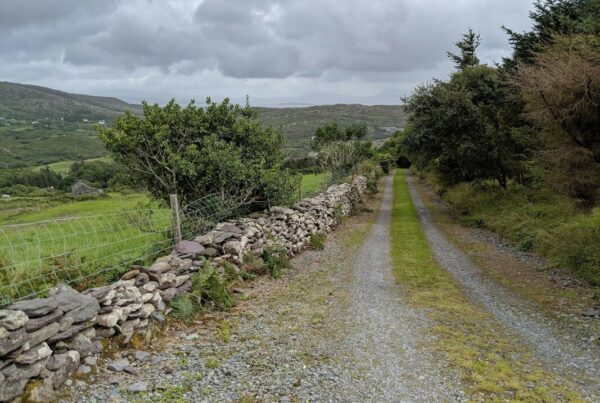
Much of rural Ireland has no footpath, no public lighting and a hedgerow in place of a verge. The Rules of the Road are specific: where there is a footpath you must use it, and where there is none you should walk as near as possible to the right-hand side, facing oncoming traffic, in single file if the road is narrow or busy. Facing the traffic gives you the chance to step in; walking with your back to it gives you nothing.
If a familiar route has become genuinely unsafe, report it rather than absorb it. Footpath surfaces, missing dropped kerbs, overgrown hedges and faded crossing markings are all local authority responsibilities, and most councils take reports online or by phone. Crossing timings can be raised the same way, and Age Friendly Ireland programmes operate in every local authority area precisely to take this kind of submission seriously.
The health checks that are also road safety checks
A few of the things that keep you safe on the road are not road measures at all.
- Vision. Have your sight tested regularly, and ask about contrast sensitivity and glare, not just the letters on the chart. Free or subsidised tests are available under the medical card and the PRSI Treatment Benefit Scheme.
- Hearing. Electric and hybrid vehicles are close to silent at low speed. They are legally required to emit a sound when moving slowly, but the margin is thin if your hearing has dulled.
- Medications. Sedatives, sleeping tablets, some antihistamines and blood pressure medicines that cause light-headedness on standing all affect balance and reaction time. Ask your GP or pharmacist for a medication review.
- Walking speed itself. Gait speed is one of the better predictors of health in later life, and it responds to training. Strength work for the legs, balance practice and simply walking more will all move the number in the right direction.
Walk anyway
It would be a poor outcome if anyone read the figures above and walked less. The health cost of staying indoors from October to March is far greater than the risk of the walk to the shop. Wear the vest. Step off on the green. Finish the sentence on the other side.
At Críonna Health we write about ageing well in Ireland with the evidence attached, because the practical details are where the difference is usually made. Our guides on walking for health after 50 and falls prevention cover the ground either side of this one.
This article is for general information and is not a substitute for advice from your GP or another qualified health professional.
📷 Photo by Mark Timberlake on Unsplash