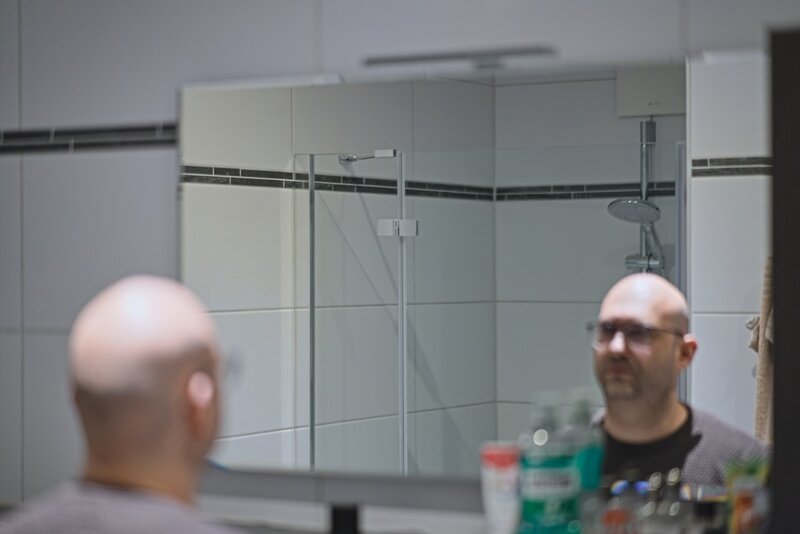
It usually happens at the bathroom mirror. You go to brush your teeth and the water runs out the side of your mouth, or you smile at your reflection and only half of your face joins in. Within the hour one eye will not close properly and your tea tastes wrong. The first thought for most people over 50 is the right one: is this a stroke? That question is not yours to answer, and whatever the answer turns out to be, the treatment that gives you the best chance of full recovery has a deadline measured in hours.
TL;DR
- Treat sudden facial weakness as a suspected stroke until a clinician says otherwise. Call 112 or 999 and note the time symptoms started.
- Bell’s palsy is the commonest cause of one-sided facial paralysis, affecting roughly 20 to 40 adults per 100,000 a year, and risk rises with age and with diabetes.
- Oral steroids started within 72 hours lift complete recovery at three months from about 64% to 83%. After that window, the benefit is no longer demonstrable.
- The most neglected part of treatment is the eye: if the lid will not close, the cornea is exposed and needs lubricating by day and covering at night.
- Ear pain with a rash (Ramsay Hunt syndrome) or weakness on both sides of the face (possible Lyme neuroborreliosis) means this is not straightforward Bell’s palsy.
Why the first phone call is always 112 or 999
You may have read that there is a simple way to tell a stroke from Bell’s palsy: check the forehead. A stroke in the brain usually spares it, because those muscles take their nerve supply from both sides of the brain. Bell’s palsy takes the whole side of the face, eyebrow included, so the person cannot wrinkle their forehead on the weak side.
That rule is real, and it is how clinicians think. It is not a home test. Strokes in the brainstem can produce a complete facial palsy that looks exactly like Bell’s palsy, and the cost of getting it wrong at your own kitchen table is a missed window for clot-busting treatment. The Irish Heart Foundation’s Act F.A.S.T. message is deliberately blunt: Face, Arms, Speech, Time, and any one of those signs means 112 or 999. Two things help the crew: note the exact time you last felt normal, and mention any arm or leg weakness, slurred speech, double vision or trouble swallowing. Bell’s palsy affects the face and nothing else.
What Bell’s palsy actually is
The facial nerve runs from the brainstem through a narrow bony channel in the skull before fanning out across the face. It does more than move muscles: it carries taste from the front of the tongue, drives tear and saliva production, and dampens loud sound in the ear. When it swells inside that rigid channel it gets compressed, and everything it supplies goes quiet at once. Hence the full picture, which is not just a drooping face but altered taste, a dry or streaming eye, and sound that seems uncomfortably loud on one side. Incidence in adults runs at roughly 20 to 40 cases per 100,000 a year and climbs with age, and diabetes raises the risk somewhere between 1.6 and 2.4 times, so anyone managing type 2 diabetes should file this one away.
The 72-hour window
This is the part that changes outcomes. A landmark Scottish trial randomised people to prednisolone, an antiviral, both or neither, all within 72 hours of onset. Complete recovery at three months was 83.0% with prednisolone against 63.6% without, and at nine months 94.4% against 81.6%. The antiviral added nothing, alone or alongside the steroid. Later analyses are consistent on timing: start after 72 hours and the benefit disappears.
Practically, that means a face that droops on a Friday evening is not a Monday morning problem. If emergency assessment rules out stroke and sends you home, a same-day prescription still matters. Out of hours, the GP co-operatives (SouthDoc, Caredoc, Shannondoc, NorthDoc, WestDoc and their equivalents) exist for exactly this, and HSE Live on 1800 700 700 will point you to the right one. A typical course is 50mg of prednisolone daily for ten days, managed differently if you have diabetes, since steroids push blood glucose up throughout.
The bit most people get wrong: your eye
Ask anyone who has had facial palsy what caused the most lasting trouble and a surprising number say the eye, not the smile. When the lid will not close fully, a condition called lagophthalmos, the cornea is exposed, and tear production on that side often drops at the same time. Left alone this causes exposure keratopathy, which can scar the cornea and damage sight permanently.
Protection is low-tech and effective: preservative-free lubricating drops through the day, a thicker ointment at night, and the eye taped or covered while you sleep. Have a pharmacist or nurse show you the taping technique rather than improvising, because tape applied badly scrapes the very cornea you are protecting. Contact lenses are best left out until the blink returns, and a red, painful eye or blurring vision is a same-day problem, not part of the package.
When it is not Bell’s palsy
Ramsay Hunt syndrome. Shingles affecting the facial nerve, caused by the chickenpox virus reactivating rather than the cold sore one. It brings severe ear pain, often a blistering rash in or around the ear, and frequently dizziness or hearing loss alongside the weakness. Most cases occur in people over 60, recovery is less complete than with Bell’s palsy, and it needs antivirals as well as steroids, urgently. Worth a conversation with your GP about shingles vaccination for precisely this reason.
Lyme neuroborreliosis. Facial palsy is the commonest nerve complication of Lyme disease, and weakness on both sides of the face is a particular red flag. Neuroborreliosis is notifiable to the HPSC here, with around 100 people testing positive for Lyme in Ireland each year. If you walk, farm or garden in tick country, mention any bite or expanding circular rash from the preceding weeks. It changes the treatment entirely.
Slow onset. Bell’s palsy arrives over hours to a couple of days, then stops progressing. Weakness that creeps in over weeks, keeps worsening after a fortnight, involves other nerves of the head, or comes with a lump near the jaw or ear needs imaging and a specialist opinion, not reassurance.
Recovery, and what to do if it lingers
Most people see movement returning within two to three weeks and are largely recovered by three to four months. A minority are left with lasting changes, and the one to know about is synkinesis: nerve fibres regrow into the wrong muscles, so the eye narrows when you smile or the mouth twitches when you blink. Among those with persisting palsy it is common, reported in around half of cases.
The instinct to do vigorous facial exercises at the mirror is understandable and unhelpful. The evidence supports facial neuromuscular retraining, which is slow, small, precise movement work guided by a therapist, plus botulinum toxin where synkinesis is established. Within the HSE this usually sits with speech and language therapy or physiotherapy: Cork University Hospital, for instance, runs a facial paresis service through speech and language therapy covering eye protection and taping as well as eating, drinking and communication. Ask for a referral rather than waiting to see whether it settles. And do not underrate the psychological side. A face that will not cooperate changes how you eat in company and how strangers read you, which is as fair a thing to raise with your GP as the tablets are.
Facial palsy is one of those conditions where an informed half hour beats a year of catching up, because nearly all the leverage sits in the first three days. At Críonna Health we write about ageing as something to navigate well rather than endure, and knowing what to do at the bathroom mirror is a fair example of what that looks like.
This article is for general information and is not a substitute for medical advice. If you have sudden facial weakness, call 112 or 999. For non-urgent queries, contact your GP or HSE Live on 1800 700 700. The Irish Heart Foundation’s nurse support line is 01 668 5001.
📷 Photo by Konstantinos Papadopoulos on Unsplash