Norovirus is a January problem that gets decided in September. By the time the HSE is issuing notices and wards are closing to admissions, the things that make a difference are already set: whether there is a bleach-based cleaner under the sink, whether anyone has rehydration sachets, and whether the family has a rule about who stays away and for how long.
Last season those notices came thick. Ireland recorded 531 confirmed cases between 1 January and 28 February 2026, with outbreaks affecting wards at Cork University Hospital, University Hospital Galway and Sligo University Hospital. For most people it is two miserable days and then nothing. After 60, and particularly where kidney disease, diabetes or heart failure is already in the picture, the arithmetic changes quickly.
TL;DR
- Alcohol hand gel does not kill norovirus. HPSC advice is soap and water for at least 20 seconds, because the virus is physically removed rather than killed.
- People shed virus for at least 48 hours after symptoms stop, which is where the 48-hour rule for work and visiting comes from.
- The real risk after 60 is dehydration progressing to acute kidney injury; new confusion is often the first visible sign.
- Surfaces need a bleach-based cleaner at roughly 1,000ppm hypochlorite; laundry needs 60°C. Detergent alone will not inactivate it.
- Ireland logged 72 cases in the last week of February 2026 against a four-year median of 34 for that week, and there is still no licensed norovirus vaccine.
Why “unpleasant but mild” is not the whole story
Dr Eimear Brannigan, HSE National Clinical Lead for Antimicrobial Resistance and Infection Control, calls norovirus “an unpleasant but mild illness that passes off quickly without any treatment” for most people. HSE guidance adds that it can be very serious for older adults and people with underlying conditions.
HPSC guidance for residential care settings is blunter about the mechanism: where vomiting is severe or prolonged, especially alongside diarrhoea, dehydration can escalate very quickly, and in the worst cases that means kidney failure. Two things make this likelier with age. Thirst sensation reduces, so the internal alarm is quieter. And many people over 60 take medicines that make fluid loss far more dangerous, including ACE inhibitors, ARBs, diuretics, metformin, SGLT2 inhibitors and NSAIDs. These are the sick day rules, and norovirus is exactly what they were written for; if you are unsure which tablets to pause, ask your pharmacist before you need to know. Watch for confusion rather than complaint, too. Sudden disorientation, or being unusually “not themselves”, is often the first sign that fluid loss has gone too far.
The 12-to-48 hour clock
Symptoms begin about 24 hours after exposure, range 12 to 48, and last 12 to 72 hours: sudden nausea, often forceful vomiting, watery diarrhoea. What makes it hard to contain is either side of that window. Vomiting sprays droplets that settle on door handles, taps and remote controls, where the virus survives for weeks, and people shed for at least two days after they feel better, some for as long as two weeks. HPSC advises avoiding food preparation until three days after symptoms have gone.
The hand gel problem
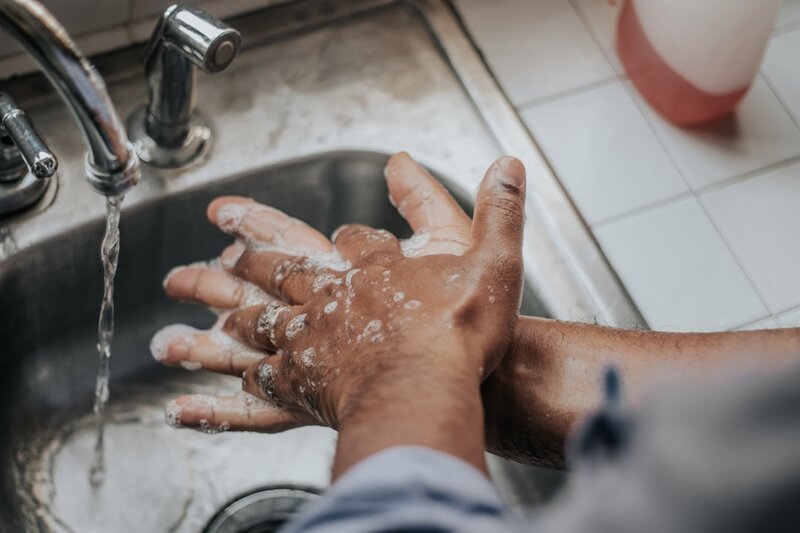
This is the single most useful thing to know, and it runs against five years of trained habit. Alcohol hand rubs work by breaking up the fatty envelope around viruses like flu and COVID-19. Norovirus has no such envelope. HPSC states it plainly: wash your hands frequently and thoroughly with soap and water, because alcohol hand gels do not kill noroviruses.
Soap works by mechanical removal, which is why duration matters: twenty seconds, roughly the time it takes to sing “Happy Birthday” to yourself twice, then dry on a towel nobody else is using. Wash after using the toilet, after attending to anyone vomiting, after handling soiled bedding, and before touching food. The dispenser at the nursing home door does useful work against plenty of other things. Not this one.
Cleaning that actually works
The sequence HPSC recommends is cover, clear, then clean. Cover the area with paper towels, move everyone away, and clean it wearing rubber gloves: scoop with a plastic dustpan, flush it, wash with detergent and hot water, then disinfect with a 0.1% hypochlorite solution. That is around 1,000ppm, broadly one part household bleach to 50 parts water, though concentrations vary so follow the bottle. Allow contact time rather than wiping straight off.
Three details get missed. Laundry needs at least 60°C, washed separately. High-touch surfaces matter as much as the floor: flush handle, door handle, taps, light switches, the TV remote. And flush the toilet with the seat and lid down every time, because an open-lid flush sprays the contents across the bathroom.
The 48-hour rule, and what it asks of families
Dr Paul McKeown, Consultant in Public Health Medicine with HSE National Health Protection, put the ask simply during last February’s surge: stay off work or school for at least 48 hours after symptoms have passed, and avoid visiting anyone in hospital or a care home, or socialising, while sick and for 48 hours after.
Two corollaries. Do not bring vomiting and diarrhoea into an emergency department if you can avoid it; ring your pharmacist or GP instead. If you are genuinely unwell then go, but tell reception on arrival so precautions can be taken. And if two people in the same house or unit start vomiting within a day of each other, treat it as an outbreak, because it almost certainly is one. If a nursing home restricts visiting, that is a defined process rather than obstruction: an outbreak is declared over only once 48 hours have passed since the last case’s symptoms resolved, 72 hours since the most recent new onset, and terminal cleaning is complete.
Looking after someone at home
There is no specific treatment; the whole job is fluid. Small, frequent sips work far better than large drinks that come straight back up, and oral rehydration sachets from the pharmacy replace salts plain water does not. Do not reach for anti-diarrhoeal medicines without advice.
Contact your GP or the out-of-hours service if the person passes little or no urine over eight to twelve hours, becomes confused or unusually drowsy, cannot keep fluid down beyond twelve hours, has blood in their stool or severe abdominal pain, or is still symptomatic after three days.
Why you keep getting it, and why there is still no vaccine
Immunity is short-lived and there are many circulating strains, so a previous dose offers limited protection. The picture has shifted recently, with GII.17 displacing the long-dominant GII.4; Ireland was among six European countries reporting increased GII.17 circulation in 2023/24. A vaccine would change the calculation for people in their 70s and 80s, but none is licensed. Moderna’s trivalent candidate entered phase 3 in September 2024, recruiting up to 20,000 participants aged 60 and over, and in August 2026 the company reported it had not met the criteria for early success. For this winter, behaviour is the only tool we have.
A ten-minute job, this month
- Put a bleach-based cleaner and a pair of dedicated rubber gloves under the sink.
- Buy two sachets of oral rehydration salts and store them where you would find them at 3am.
- Agree the family rule out loud now, so nobody feels awkward saying it in January.
At Críonna Health we keep returning to the same observation: the measures that protect independence in later life are cheap, unglamorous and decided months before they are needed. This is one of them.
This article is for general information and is not a substitute for medical advice. If you are concerned about dehydration or a prolonged stomach illness, contact your GP or out-of-hours service.
📷 Photo by Mélissa Jeanty on Unsplash