There is a particular kind of person standing on the sideline of an Irish pitch on a Saturday morning. They played until they were 30, maybe 35. Then work got busy, a knee went, a child arrived, and the gear bag went into the attic. Twenty years on they are still on the sideline, in a coat, watching, quietly certain that the playing part of their life is finished.
It very often is not. Irish sport has quietly built a whole tier of formats for people in their 50s, 60s, 70s and beyond, and the research suggests that playing with other people may be worth far more than the same hour alone on a treadmill.
TL;DR
- Sport participation drops sharply with age in Ireland: 42% of 45-64 year olds and 30% of over-65s took part in 2025, against 55% of 25-44 year olds (Irish Sports Monitor 2025).
- The Copenhagen City Heart Study followed 8,577 adults for up to 25 years and found the biggest life expectancy gains in the most social sports: tennis 9.7 years and badminton 6.2 years, against 1.5 years for solo gym activity.
- Ireland now has age-adapted formats: walking football (men 50+, women 40+), the Go for Life Games, Gaelic4Mothers&Others in over 400 clubs, and masters athletics from age 35 in five-year brackets.
- Club membership is the part most people skip: 37% of Irish adults belong to a sports club, and the club is where the social benefit actually lives.
- Come back gradually over weeks, not in one heroic session, and talk to your GP first if you have a heart, lung or joint condition.
Ireland stops playing somewhere around 45
The Irish Sports Monitor, Sport Ireland’s annual survey, tracks this with uncomfortable clarity. In 2025, 55% of adults aged 25 to 44 took part in sport regularly. That falls to 42% among 45 to 64 year olds and 30% among those aged 65 and over.
The encouraging half of the picture is the direction of travel. Since the 2017 baseline, participation has risen from 35% to 42% among 45 to 64 year olds and from 25% to 30% among people aged 65 and over. Older age groups are driving the improvement, not holding it back.
The figure worth pausing on is club membership. Around 37% of Irish adults belong to a sports club, roughly 1.61 million people, and a further 11% volunteer with one. Membership is not fitness. It is the fixture in the diary, the lift arranged, and the person who notices when you do not turn up two weeks running.
Why playing with other people seems to count for more
The most striking evidence comes from the Copenhagen City Heart Study, published in Mayo Clinic Proceedings in 2018, which followed 8,577 adults for up to 25 years and compared life expectancy across different leisure activities.
The gains, measured against a sedentary group, were not evenly spread. Tennis was associated with 9.7 additional years, badminton 6.2, soccer 4.7, cycling 3.7, swimming 3.4, jogging 3.2, calisthenics 3.1 and health club activity 1.5. The three at the top all share a feature the ones at the bottom lack: you cannot do them on your own. Somebody has to be at the other end.
A caveat matters here. This is an observational study, so it cannot prove the social element causes the difference, and people who play doubles tennis into their 70s may differ from the rest of us in ways no adjustment captures. But the pattern fits what we know about loneliness and health, and it is a fair argument for choosing the format that comes with company.
What is actually available here
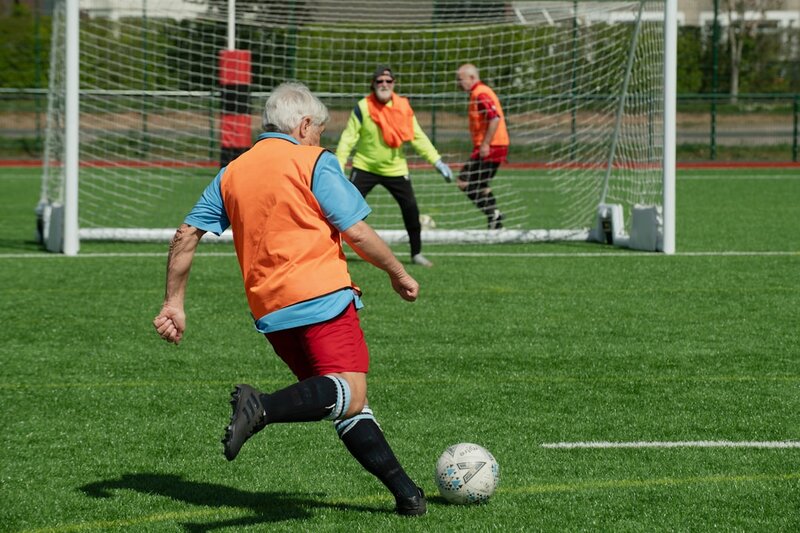
Walking football. Non-contact, no running, simplified rules, and open to men aged 50 and over and women aged 40 and over. The FAI runs it with Age & Opportunity, Healthy Ireland, Sport Ireland and the Irish Men’s Sheds Association, and their 2026-2029 strategy aims to grow it from roughly 1,000 participants to 5,000 by the end of 2029, with teams in every county.
Go for Life. Age & Opportunity’s national programme for people over 50, delivered with Local Sports Partnerships and the HSE, with roughly 40,000 people taking part annually. The Go for Life Games use three adapted games, Malai, Scidils and Flisk, played non-competitively with participants umpiring themselves. There is also a national grant scheme for older adults’ groups.
Gaelic4Mothers&Others. The LGFA’s social football initiative for women aged 25 and over who are not playing competitively now runs in over 400 clubs across all 32 counties. Blitzes rather than leagues, and a great many women playing their first sport in decades.
Masters athletics. If the competitive itch never left, masters athletics starts at 35 and runs in five-year age brackets through to 100 and over, so you race people your own age rather than your children’s. Athletics Ireland’s masters squads span ages 35 to 87.
Beyond those, most bowls, golf, swimming, badminton and rowing clubs have a recreational or masters section, and many never advertise it.
Coming back without hurting yourself
The risk in returning to sport is rarely the sport. It is the gap between what your head remembers and what your tendons have been doing for twenty years.
- Talk to your GP first if you have heart or lung disease, uncontrolled blood pressure, diabetes, a recent operation, or joint problems that limit daily activity. Usually the advice is to go ahead, but on a specific plan.
- Build over six to eight weeks. Tendons adapt more slowly than muscles and far more slowly than enthusiasm. A soft first month prevents the calf and Achilles injuries that end most comebacks in week three.
- Warm up properly, ten minutes minimum, rather than treating it as something the younger players do.
- Use the two-day rule. Ordinary stiffness settles within 48 hours; sharp pain, swelling or soreness still worsening on day three needs looking at.
- Stop and seek help for chest pain or tightness, breathlessness out of proportion to the effort, dizziness or blackouts. Never “just being unfit”.
Ireland’s national physical activity guidelines ask for at least 150 minutes of moderate activity a week plus muscle-strengthening on two days, with balance work added for older adults. A weekly club session rarely covers all of that, but it is the part people keep doing, which makes it the part that counts.
Finding your way in
Your Local Sports Partnership is the best starting point, and there is one in every county. They hold the lists, run taster days, and know which clubs genuinely have an older adults’ section rather than just a line on a website. Active Retirement Ireland groups, Men’s Sheds and local Age Friendly programmes are worth a call too.
When you ring, ask the specific question: is there a social, walking or masters section, and when does it train?
At Críonna Health we return to this repeatedly, because so much of ageing well in Ireland is practical rather than medical. The hard part is rarely the exercise. It is the first phone call, and the willingness to be the newest person in the room at 62.
The gear bag is still in the attic. Somebody near you is short a player.
📷 Photo by Age Cymru (@agecymru) on Unsplash